End-of-Chapter Exercises
00:00
Overview
This page provides comprehensive Ch 5: Circles - End-of-Chapter Exercises. Practice advanced circle geometry proofs, chord-splitting intersection models, cyclic quadrilateral area derivations (Brahmagupta's formula), concyclic point structures, and angle bisector theorems with detailed, interactive solutions.
Advanced Circle Geometry Theorems & Proofs
Q1: Chord Length Calculation
In a circle, a chord is $5\text{ cm}$ away from the centre. If the radius of the circle is $13\text{ cm}$, what is the length of the chord?
Let the chord be $AB$, and let $OM$ be the perpendicular from center $O$ to $AB$.
• Radius $r = OA = 13\text{ cm}$.
• Perpendicular distance $d = OM = 5\text{ cm}$.
• Radius $r = OA = 13\text{ cm}$.
• Perpendicular distance $d = OM = 5\text{ cm}$.
In right-angled triangle $\Delta OMA$, by Baudhāyana-Pythagoras theorem:
$$OA^2 = OM^2 + AM^2 \implies 13^2 = 5^2 + AM^2$$
$$169 = 25 + AM^2 \implies AM^2 = 144 \implies AM = 12\text{ cm}$$
$$OA^2 = OM^2 + AM^2 \implies 13^2 = 5^2 + AM^2$$
$$169 = 25 + AM^2 \implies AM^2 = 144 \implies AM = 12\text{ cm}$$
Since the perpendicular from the centre bisects the chord:
$$\text{Chord Length } AB = 2 \times AM = 2 \times 12 = \mathbf{24\text{ cm}}$$
$$\text{Chord Length } AB = 2 \times AM = 2 \times 12 = \mathbf{24\text{ cm}}$$
Length of chord = 24 cm
Q2: Angle Subtended by Arc
An arc of a circle subtends an angle of $70^\circ$ at the centre. What is the measure of the angle subtended by the arc at a point on the circle?
By the central angle theorem: "The angle subtended by an arc at the centre is double the angle subtended by it at any point on the remaining part of the circle."
Let $\theta$ be the angle subtended at the circumference:
$$\text{Central Angle} = 2\theta \implies 70^\circ = 2\theta \implies \theta = \frac{70^\circ}{2} = \mathbf{35^\circ}$$
$$\text{Central Angle} = 2\theta \implies 70^\circ = 2\theta \implies \theta = \frac{70^\circ}{2} = \mathbf{35^\circ}$$
Angle = 35°
Q3: Chord Distance from Centre
The diameter of a circle is $26\text{ cm}$. A chord of length $24\text{ cm}$ is drawn in the circle. Find the distance from the centre of the circle to the chord.
• Radius $r = \text{Diameter} / 2 = 26 / 2 = 13\text{ cm}$.
• Perpendicular from the centre bisects the chord, so the half-chord length is $24 / 2 = 12\text{ cm}$.
• Perpendicular from the centre bisects the chord, so the half-chord length is $24 / 2 = 12\text{ cm}$.
Using the Baudhāyana-Pythagoras theorem in right triangle $\Delta OMA$:
$$r^2 = d^2 + (\text{half-chord})^2 \implies 13^2 = d^2 + 12^2$$
$$169 = d^2 + 144 \implies d^2 = 25 \implies d = \mathbf{5\text{ cm}}$$
$$r^2 = d^2 + (\text{half-chord})^2 \implies 13^2 = d^2 + 12^2$$
$$169 = d^2 + 144 \implies d^2 = 25 \implies d = \mathbf{5\text{ cm}}$$
Distance = 5 cm
Q4: Chord Length from Distance
A circle has a radius of $15\text{ cm}$. A chord is drawn. The distance from the centre of the circle to the chord is $9\text{ cm}$. What is the length of the chord?
• Radius $r = 15\text{ cm}$.
• Perpendicular distance $d = 9\text{ cm}$.
• Perpendicular distance $d = 9\text{ cm}$.
Using Baudhāyana-Pythagoras theorem in the right triangle:
$$\text{Half-chord length } x = \sqrt{r^2 - d^2} = \sqrt{15^2 - 9^2} = \sqrt{225 - 81} = \sqrt{144} = 12\text{ cm}$$
$$\text{Half-chord length } x = \sqrt{r^2 - d^2} = \sqrt{15^2 - 9^2} = \sqrt{225 - 81} = \sqrt{144} = 12\text{ cm}$$
$$\text{Total Chord Length} = 2x = 2 \times 12 = \mathbf{24\text{ cm}}$$
Length of chord = 24 cm
Q5: Perpendicular Bisector Theorem
Prove that the perpendicular bisector of a chord passes through the centre of the circle.
Let $AB$ be a chord. Let line $L$ be the perpendicular bisector of $AB$, intersecting $AB$ at its midpoint $M$.
Let $O$ be the centre of the circle. Join $OA$ and $OB$.
Let $O$ be the centre of the circle. Join $OA$ and $OB$.
Compare triangles $\Delta OMA$ and $\Delta OMB$:
1. $OA = OB$ (radii of circle)
2. $AM = BM$ ($M$ is midpoint of $AB$)
3. $OM = OM$ (common side)
1. $OA = OB$ (radii of circle)
2. $AM = BM$ ($M$ is midpoint of $AB$)
3. $OM = OM$ (common side)
By SSS congruence criterion, $\Delta OMA \cong \Delta OMB$.
This implies:
$$\angle OMA = \angle OMB$$
This implies:
$$\angle OMA = \angle OMB$$
Since $A-M-B$ is a straight line, $\angle OMA$ and $\angle OMB$ form a linear pair:
$$\angle OMA + \angle OMB = 180^\circ \implies 2\angle OMA = 180^\circ \implies \angle OMA = 90^\circ$$
This proves that the line segment joining the centre $O$ to the midpoint $M$ is perpendicular to $AB$. Thus, the perpendicular bisector $L$ must pass through $O$.
$$\angle OMA + \angle OMB = 180^\circ \implies 2\angle OMA = 180^\circ \implies \angle OMA = 90^\circ$$
This proves that the line segment joining the centre $O$ to the midpoint $M$ is perpendicular to $AB$. Thus, the perpendicular bisector $L$ must pass through $O$.
Proved using SSS congruence.
Q6: Angle in a Semicircle
The diameter of a circle is $AB$. Point $C$ is on the circumference. What is the measure of the $\angle ACB$? Explain your reasoning.
Since $AB$ is the diameter, the arc $ACB$ forms a semicircle.
• The central angle subtended by the diameter $AB$ at the centre $O$ is a straight line angle, which is exactly $180^\circ$.
• The central angle subtended by the diameter $AB$ at the centre $O$ is a straight line angle, which is exactly $180^\circ$.
By the central angle theorem, the angle subtended by the arc at any point $C$ on the circumference is half of the central angle:
$$\angle ACB = \frac{1}{2} \times 180^\circ = \mathbf{90^\circ}$$
Therefore, the measure of $\angle ACB$ is $90^\circ$ (angle in a semicircle is a right angle).
$$\angle ACB = \frac{1}{2} \times 180^\circ = \mathbf{90^\circ}$$
Therefore, the measure of $\angle ACB$ is $90^\circ$ (angle in a semicircle is a right angle).
∠ACB = 90°
Q7: Cyclic Quadrilateral Angles
$ABCD$ is a cyclic quadrilateral inscribed in a circle. If $\angle A$ measures $75^\circ$, what is the measure of $\angle C$? If $\angle B$ measures $110^\circ$, what is the measure of $\angle D$?
By the cyclic quadrilateral theorem, opposite angles of a cyclic quadrilateral are supplementary (their sum is $180^\circ$).
$$\angle A + \angle C = 180^\circ \implies 75^\circ + \angle C = 180^\circ \implies \angle C = \mathbf{105^\circ}$$
$$\angle B + \angle D = 180^\circ \implies 110^\circ + \angle D = 180^\circ \implies \angle D = \mathbf{70^\circ}$$
∠C = 105° ∠D = 70°
Q8: Solve for x in Cyclic Quadrilateral
Quadrilateral $PQRS$ is inscribed in a circle. If $\angle P = (2x + 10)^\circ$ and $\angle R = (3x - 20)^\circ$, find the value of $x$ and the measures of $\angle P$ and $\angle R$.
Since $PQRS$ is inscribed in a circle, it is a cyclic quadrilateral. The opposite angles $\angle P$ and $\angle R$ are supplementary:
$$\angle P + \angle R = 180^\circ$$
$$(2x + 10) + (3x - 20) = 180$$
$$\angle P + \angle R = 180^\circ$$
$$(2x + 10) + (3x - 20) = 180$$
$$5x - 10 = 180 \implies 5x = 190 \implies x = \mathbf{38}$$
Now calculate the angles:
• $\angle P = 2(38) + 10 = 76 + 10 = \mathbf{86^\circ}$
• $\angle R = 3(38) - 20 = 114 - 20 = \mathbf{94^\circ}$
• $\angle P = 2(38) + 10 = 76 + 10 = \mathbf{86^\circ}$
• $\angle R = 3(38) - 20 = 114 - 20 = \mathbf{94^\circ}$
x = 38 ∠P = 86° ∠R = 94°
Q9: Find Radius from Chord Length
The distance of a chord of length $16\text{ cm}$ from the centre of a circle is $6\text{ cm}$. Find the radius of the circle.
• Perpendicular distance $d = 6\text{ cm}$.
• Half-chord length $x = 16 / 2 = 8\text{ cm}$.
• Half-chord length $x = 16 / 2 = 8\text{ cm}$.
Using the Baudhāyana-Pythagoras theorem in right triangle:
$$\text{Radius } r = \sqrt{d^2 + x^2} = \sqrt{6^2 + 8^2} = \sqrt{36 + 64} = \sqrt{100} = \mathbf{10\text{ cm}}$$
$$\text{Radius } r = \sqrt{d^2 + x^2} = \sqrt{6^2 + 8^2} = \sqrt{36 + 64} = \sqrt{100} = \mathbf{10\text{ cm}}$$
Radius = 10 cm
Q10: Area of Cyclic Quadrilateral
A cyclic quadrilateral has sides $5, 5, 12, 12\text{ units}$. Find its area.
Let the sides of the cyclic quadrilateral be $a=5, b=5, c=12, d=12$.
Use **Brahmagupta's formula**:
$$\text{Area} = \sqrt{(s-a)(s-b)(s-c)(s-d)}$$
where $s$ is the semi-perimeter:
$$s = \frac{a+b+c+d}{2} = \frac{5+5+12+12}{2} = \frac{34}{2} = 17$$
Use **Brahmagupta's formula**:
$$\text{Area} = \sqrt{(s-a)(s-b)(s-c)(s-d)}$$
where $s$ is the semi-perimeter:
$$s = \frac{a+b+c+d}{2} = \frac{5+5+12+12}{2} = \frac{34}{2} = 17$$
Calculate the area:
$$\text{Area} = \sqrt{(17-5)(17-5)(17-12)(17-12)} = \sqrt{12 \times 12 \times 5 \times 5} = 12 \times 5 = \mathbf{60\text{ sq. units}}$$
$$\text{Area} = \sqrt{(17-5)(17-5)(17-12)(17-12)} = \sqrt{12 \times 12 \times 5 \times 5} = 12 \times 5 = \mathbf{60\text{ sq. units}}$$
Area = 60 sq. units
Q11: Circumcentre Position Conjecture
Consider a cyclic quadrilateral. Without drawing its circumcircle, how can we find out whether the centre of the circumcircle lies inside the quadrilateral or outside? What is the best way of finding out?
Let the cyclic quadrilateral be $ABCD$ inscribed in a circle with center $O$.
• The center $O$ lies **inside** the quadrilateral if and only if all four arcs subtended by the sides ($AB, BC, CD, DA$) are minor arcs (i.e. each central angle is $< 180^\circ$).
• The center $O$ lies **inside** the quadrilateral if and only if all four arcs subtended by the sides ($AB, BC, CD, DA$) are minor arcs (i.e. each central angle is $< 180^\circ$).
• **Best check using angle criterion**:
Let $P$ be the intersection of the diagonals. If the perpendicular projections of $O$ onto all sides lie within the boundaries of the sides, $O$ is inside.
Alternatively, if any side subtends an obtuse angle at the circumference that is greater than $90^\circ$ (which means its central angle $> 180^\circ$), the centre $O$ must lie **outside** the quadrilateral. Since opposite angles sum to $180^\circ$, if a diagonal divides it into two triangles and both are acute, the centre lies inside.
Let $P$ be the intersection of the diagonals. If the perpendicular projections of $O$ onto all sides lie within the boundaries of the sides, $O$ is inside.
Alternatively, if any side subtends an obtuse angle at the circumference that is greater than $90^\circ$ (which means its central angle $> 180^\circ$), the centre $O$ must lie **outside** the quadrilateral. Since opposite angles sum to $180^\circ$, if a diagonal divides it into two triangles and both are acute, the centre lies inside.
Centre lies inside if all sides subtended central angles are < 180°.
Q12: Intersecting Congruent Chords
When two chords intersect, each of them is divided into two line segments. Show that if the intersecting chords are of equal length, then the line segments of one chord are equal to the corresponding line segments of the other chord.
Let $AB$ and $CD$ be two equal chords of a circle with centre $O$, intersecting at point $P$.
• Draw perpendiculars $OM \perp AB$ and $ON \perp CD$. Since equal chords are equidistant from the centre:
$$OM = ON$$
• Draw perpendiculars $OM \perp AB$ and $ON \perp CD$. Since equal chords are equidistant from the centre:
$$OM = ON$$
In right-angled triangles $\Delta OMP$ and $\Delta ONP$:
1. $\angle OMP = \angle ONP = 90^\circ$ (perpendicularity)
2. $OP = OP$ (common hypotenuse)
3. $OM = ON$ (equal chord distance)
By RHS congruence: $\Delta OMP \cong \Delta ONP \implies MP = NP$.
1. $\angle OMP = \angle ONP = 90^\circ$ (perpendicularity)
2. $OP = OP$ (common hypotenuse)
3. $OM = ON$ (equal chord distance)
By RHS congruence: $\Delta OMP \cong \Delta ONP \implies MP = NP$.
Since the perpendicular from the centre bisects the chords:
• $AM = MB = \frac{AB}{2}$
• $CN = ND = \frac{CD}{2}$
Since $AB = CD \implies AM = CN$ and $MB = ND$.
• $AM = MB = \frac{AB}{2}$
• $CN = ND = \frac{CD}{2}$
Since $AB = CD \implies AM = CN$ and $MB = ND$.
Now compute corresponding segments:
• $AP = AM + MP = CN + NP = CP \implies \mathbf{AP = CP}$
• $BP = MB - MP = ND - NP = DP \implies \mathbf{BP = DP}$
This proves that the segments of one chord are equal to the corresponding segments of the other.
• $AP = AM + MP = CN + NP = CP \implies \mathbf{AP = CP}$
• $BP = MB - MP = ND - NP = DP \implies \mathbf{BP = DP}$
This proves that the segments of one chord are equal to the corresponding segments of the other.
Proved: AP = CP and BP = DP.
Q13: Chord Distance Geometry
Draw a circle in which a chord of $6\text{ cm}$ length stands at a distance of $3\text{ cm}$ from the centre.
(Hint: Is it a circumcircle of a suitable triangle?)
(Hint: Is it a circumcircle of a suitable triangle?)
Let chord be $AB = 6\text{ cm}$ and distance $OM = 3\text{ cm}$ where $M$ is midpoint of $AB$.
• Half-chord $AM = 3\text{ cm}$.
• Perpendicular distance $OM = 3\text{ cm}$.
• Half-chord $AM = 3\text{ cm}$.
• Perpendicular distance $OM = 3\text{ cm}$.
In right triangle $\Delta OMA$, since $AM = OM = 3\text{ cm}$, it is an isosceles right-angled triangle.
• $\angle AOM = \angle OAM = 45^\circ$.
• Radius $OA = \sqrt{OM^2 + AM^2} = \sqrt{3^2 + 3^2} = \mathbf{3\sqrt{2}\text{ cm} \approx 4.24\text{ cm}}$.
• $\angle AOM = \angle OAM = 45^\circ$.
• Radius $OA = \sqrt{OM^2 + AM^2} = \sqrt{3^2 + 3^2} = \mathbf{3\sqrt{2}\text{ cm} \approx 4.24\text{ cm}}$.
This circle is the circumcircle of an isosceles right-angled triangle $\Delta OAB$ where the central angle $\angle AOB = 90^\circ$ and radius is $3\sqrt{2}\text{ cm}$.
Circumradius is 3√2 cm (≈ 4.24 cm) and central angle is 90°.
Q14: Cyclic Parallelogram
Show that rectangle is the only parallelogram that can be inscribed in a circle.
Let $ABCD$ be a parallelogram inscribed in a circle.
• Since it is inscribed in a circle, $ABCD$ is a cyclic quadrilateral.
• Therefore, opposite angles sum to $180^\circ$:
$$\angle A + \angle C = 180^\circ$$
• Since it is inscribed in a circle, $ABCD$ is a cyclic quadrilateral.
• Therefore, opposite angles sum to $180^\circ$:
$$\angle A + \angle C = 180^\circ$$
• In any parallelogram, opposite angles are equal:
$$\angle A = \angle C$$
$$\angle A = \angle C$$
Substitute $\angle C = \angle A$ into the sum equation:
$$2\angle A = 180^\circ \implies \angle A = 90^\circ$$
Since a parallelogram with one right angle is a rectangle, all angles of $ABCD$ are $90^\circ$.
Thus, $ABCD$ is a rectangle.
$$2\angle A = 180^\circ \implies \angle A = 90^\circ$$
Since a parallelogram with one right angle is a rectangle, all angles of $ABCD$ are $90^\circ$.
Thus, $ABCD$ is a rectangle.
Proved: Opposite angles must be equal and supplementary, so they are 90°.
Q15: Diagonals of Inscribed Rectangle
Show that if a rectangle is inscribed in a circle, then the point of intersection of its diagonals must lie at the centre of the circle.
Let $ABCD$ be a rectangle inscribed in a circle.
• The diagonals $AC$ and $BD$ of a rectangle are equal and bisect each other at a point $P$.
• The diagonals $AC$ and $BD$ of a rectangle are equal and bisect each other at a point $P$.
• Since $\angle ABC = 90^\circ$, $AC$ subtends a right angle on the circumference.
• By theorem, the chord subtending $90^\circ$ on the circumference must be a diameter of the circle. Thus, diagonal $AC$ is a diameter.
• Similarly, diagonal $BD$ is also a diameter.
• By theorem, the chord subtending $90^\circ$ on the circumference must be a diameter of the circle. Thus, diagonal $AC$ is a diameter.
• Similarly, diagonal $BD$ is also a diameter.
• The diameters of a circle always intersect at the centre of the circle.
• Therefore, the diagonal intersection point $P$ must be the centre of the circle.
• Therefore, the diagonal intersection point $P$ must be the centre of the circle.
Proved: Diagonals AC and BD are diameters, so they intersect at the centre.
Q16: Locus of Midpoints of Chords
Consider all chords of a circle of a fixed length. What is the shape formed by the midpoints of all these chords?
Let the fixed length of the chords be $l$.
• By theorem, all chords of equal length in a circle are equidistant from the centre.
• This means the perpendicular distance $d$ of the midpoint of each chord from the centre $O$ is constant:
$$d = \sqrt{r^2 - \left(\frac{l}{2}\right)^2}$$
• By theorem, all chords of equal length in a circle are equidistant from the centre.
• This means the perpendicular distance $d$ of the midpoint of each chord from the centre $O$ is constant:
$$d = \sqrt{r^2 - \left(\frac{l}{2}\right)^2}$$
The set of all points that are at a constant distance $d$ from the fixed centre $O$ forms a **circle**.
Therefore, the shape formed by the midpoints is a concentric circle of radius $d$.
Therefore, the shape formed by the midpoints is a concentric circle of radius $d$.
Concentric circle of radius d = √(r² - l²/4)
Q17: Angle Bisector Chord Theorem
In a circle with centre $O$, chords $AB$ and $AC$ are congruent. Explain why this statement is true: “The centre of the circle lies on the angle bisector of $\angle BAC$”.
Join the centre $O$ to vertices $A$, $B$, and $C$.
Compare triangles $\Delta OAB$ and $\Delta OAC$:
1. $AB = AC$ (given congruent chords)
2. $OA = OA$ (common side)
3. $OB = OC$ (radii of circle)
Compare triangles $\Delta OAB$ and $\Delta OAC$:
1. $AB = AC$ (given congruent chords)
2. $OA = OA$ (common side)
3. $OB = OC$ (radii of circle)
By SSS congruence criterion, $\Delta OAB \cong \Delta OAC$.
This implies:
$$\angle OAB = \angle OAC$$
This implies:
$$\angle OAB = \angle OAC$$
Since $\angle OAB = \angle OAC$, the line segment $AO$ bisects the angle $\angle BAC$.
Therefore, the centre $O$ lies on the angle bisector of $\angle BAC$.
Therefore, the centre $O$ lies on the angle bisector of $\angle BAC$.
Proved using SSS congruence of ΔOAB and ΔOAC.
Q18: Parallel Chords on Same Side
Two parallel chords of lengths $10\text{ cm}$ and $24\text{ cm}$ are on the same side of the centre of a circle. The distance between the chords is $7\text{ cm}$. Find the radius of the circle.
Let $AB = 10\text{ cm}$ and $CD = 24\text{ cm}$ be the parallel chords. Let $O$ be the centre and $r$ be the radius.
Draw perpendicular from $O$ meeting $AB$ at $M$ and $CD$ at $N$.
• $AM = 10 / 2 = 5\text{ cm}$.
• $CN = 24 / 2 = 12\text{ cm}$.
Let $ON = x$. Since the distance between chords is $7\text{ cm}$, $OM = x + 7$.
Draw perpendicular from $O$ meeting $AB$ at $M$ and $CD$ at $N$.
• $AM = 10 / 2 = 5\text{ cm}$.
• $CN = 24 / 2 = 12\text{ cm}$.
Let $ON = x$. Since the distance between chords is $7\text{ cm}$, $OM = x + 7$.
In right triangle $\Delta ONC$:
$$r^2 = ON^2 + CN^2 = x^2 + 12^2 = x^2 + 144 \quad \text{--- (Equation 1)}$$
$$r^2 = ON^2 + CN^2 = x^2 + 12^2 = x^2 + 144 \quad \text{--- (Equation 1)}$$
In right triangle $\Delta OMA$:
$$r^2 = OM^2 + AM^2 = (x + 7)^2 + 5^2 = x^2 + 14x + 49 + 25 = x^2 + 14x + 74 \quad \text{--- (Equation 2)}$$
$$r^2 = OM^2 + AM^2 = (x + 7)^2 + 5^2 = x^2 + 14x + 49 + 25 = x^2 + 14x + 74 \quad \text{--- (Equation 2)}$$
Equate Equation 1 and Equation 2:
$$x^2 + 144 = x^2 + 14x + 74 \implies 14x = 70 \implies x = 5\text{ cm}$$
$$x^2 + 144 = x^2 + 14x + 74 \implies 14x = 70 \implies x = 5\text{ cm}$$
Substitute $x = 5$ into Equation 1:
$$r^2 = 5^2 + 144 = 25 + 144 = 169 \implies r = \mathbf{13\text{ cm}}$$
$$r^2 = 5^2 + 144 = 25 + 144 = 169 \implies r = \mathbf{13\text{ cm}}$$
Radius = 13 cm
Q19: Regular Hexagon Inscribed
A regular hexagon is inscribed in a circle of radius $r$. Find the length of the sides of the hexagon and the distance of each side from the centre of the circle.
(i) Side length:
A regular hexagon inscribed in a circle consists of 6 congruent equilateral triangles with vertices at the centre.
Therefore, the side length $s$ of the hexagon is equal to the radius:
$$s = \mathbf{r}$$
A regular hexagon inscribed in a circle consists of 6 congruent equilateral triangles with vertices at the centre.
Therefore, the side length $s$ of the hexagon is equal to the radius:
$$s = \mathbf{r}$$
(ii) Distance from the centre:
This distance $d$ is the altitude of one of the equilateral triangles of side $r$.
$$d = r\sin(60^\circ) = \mathbf{\frac{\sqrt{3}}{2} r \approx 0.866 r}$$
This distance $d$ is the altitude of one of the equilateral triangles of side $r$.
$$d = r\sin(60^\circ) = \mathbf{\frac{\sqrt{3}}{2} r \approx 0.866 r}$$
Side = r Distance = (√3/2)r
Q20: Diameter Subtensions
A quadrilateral $MNOP$ is inscribed in a circle. If $MN$ is a diameter, what can you say about $\angle MOP$ and $\angle MNP$? Explain your reasoning.
Since the points $M, N, O, P$ lie on the circle, the segments $MP$ forms a chord.
• The angles $\angle MOP$ and $\angle MNP$ have their vertices $O$ and $N$ on the circumference.
• Both angles are subtended by the same chord $MP$ on the same segment of the circle.
• The angles $\angle MOP$ and $\angle MNP$ have their vertices $O$ and $N$ on the circumference.
• Both angles are subtended by the same chord $MP$ on the same segment of the circle.
By the theorem: "Angles subtended by an arc in the same segment of a circle are equal."
$$\mathbf{\angle MOP = \angle MNP}$$
$$\mathbf{\angle MOP = \angle MNP}$$
∠MOP = ∠MNP because they are in the same segment.
Q21: Exterior Angle of Cyclic Quadrilateral
Let $ABCD$ be a cyclic quadrilateral. Explain why the exterior angle at any vertex is equal to the interior opposite angle (e.g., $\angle CDE = \angle ABC$, where $E$ is a point on the extension of side $CD$).
• In cyclic quadrilateral $ABCD$, opposite angles are supplementary:
$$\angle ABC + \angle ADC = 180^\circ \quad \text{--- (Equation 1)}$$
$$\angle ABC + \angle ADC = 180^\circ \quad \text{--- (Equation 1)}$$
• Since $E$ lies on the extension of $CD$, the points $C, D, E$ lie on a straight line. The angles $\angle ADC$ and $\angle CDE$ form a linear pair:
$$\angle ADC + \angle CDE = 180^\circ \quad \text{--- (Equation 2)}$$
$$\angle ADC + \angle CDE = 180^\circ \quad \text{--- (Equation 2)}$$
Equate Equation 1 and Equation 2:
$$\angle ABC + \angle ADC = \angle ADC + \angle CDE$$
Subtract $\angle ADC$ from both sides:
$$\mathbf{\angle CDE = \angle ABC}$$
$$\angle ABC + \angle ADC = \angle ADC + \angle CDE$$
Subtract $\angle ADC$ from both sides:
$$\mathbf{\angle CDE = \angle ABC}$$
Proved: Exterior angle equals interior opposite angle.
Q22: Max Chord Length
“There is no chord of a circle that is longer than its diameter.” How do you justify this statement?
Let $AB$ be a chord of a circle with centre $O$ and radius $r$. Let $d$ be its perpendicular distance from the centre.
• The length of the chord is:
$$AB = 2\sqrt{r^2 - d^2}$$
• The length of the chord is:
$$AB = 2\sqrt{r^2 - d^2}$$
• The distance $d$ must satisfy $d^2 \ge 0$.
• To maximize $AB$, we must minimize $d^2$. The smallest value of $d^2$ is $0$, which occurs when the chord passes directly through the centre ($d = 0$):
$$AB_{max} = 2\sqrt{r^2 - 0} = 2r = \text{Diameter}$$
• For any other chord, $d > 0 \implies AB < 2r$.
• To maximize $AB$, we must minimize $d^2$. The smallest value of $d^2$ is $0$, which occurs when the chord passes directly through the centre ($d = 0$):
$$AB_{max} = 2\sqrt{r^2 - 0} = 2r = \text{Diameter}$$
• For any other chord, $d > 0 \implies AB < 2r$.
Justified: The maximum value of 2√(r² - d²) is 2r (diameter) when d = 0.
Q23: Shortest Chord through Point
Let $A$ be any point within a given circle with centre $O$. Show that the shortest chord of the circle that passes through point $A$ is the one that is perpendicular to $OA$.
Let $CD$ be any chord passing through $A$, and let $OM$ be the perpendicular from centre $O$ to $CD$.
• In right-angled triangle $\Delta OMA$, the hypotenuse is $OA$. Thus, we always have:
$$OM \le OA$$
• In right-angled triangle $\Delta OMA$, the hypotenuse is $OA$. Thus, we always have:
$$OM \le OA$$
• The length of the chord is $CD = 2\sqrt{r^2 - OM^2}$.
• To minimize the chord length, we must maximize the perpendicular distance $OM$.
• Since $OM \le OA$, the maximum value of $OM$ is when $OM = OA$.
• To minimize the chord length, we must maximize the perpendicular distance $OM$.
• Since $OM \le OA$, the maximum value of $OM$ is when $OM = OA$.
• This maximum is achieved when $M$ coincides with $A$, meaning the perpendicular from $O$ to the chord meets it exactly at $A$.
• Hence, $OA \perp CD$, and the shortest chord is perpendicular to $OA$.
• Hence, $OA \perp CD$, and the shortest chord is perpendicular to $OA$.
Proved: Chord length is minimized when distance is maximized (i.e. OM = OA).
Q24: Angle in Semicircle Proof
How would you use the following figure to justify the statement that the angle in a semicircle is $90^\circ$?
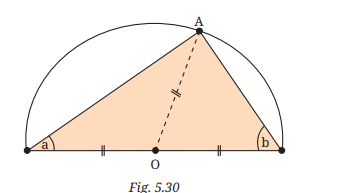
Let the diameter be $BC$ with centre $O$, and $A$ be a point on the semicircle.
• Draw $OA$. The segments $OA$, $OB$, and $OC$ are radii:
$$OA = OB = OC = r$$
• Draw $OA$. The segments $OA$, $OB$, and $OC$ are radii:
$$OA = OB = OC = r$$
• In isosceles triangle $\Delta OAB$ (since $OA = OB$):
$$\angle OAB = \angle OBA = a$$
• In isosceles triangle $\Delta OAC$ (since $OA = OC$):
$$\angle OAC = \angle OCA = b$$
$$\angle OAB = \angle OBA = a$$
• In isosceles triangle $\Delta OAC$ (since $OA = OC$):
$$\angle OAC = \angle OCA = b$$
• The total angle at vertex $A$ is:
$$\angle BAC = a + b$$
• Using the angle sum property in $\Delta ABC$:
$$\angle B + \angle C + \angle BAC = 180^\circ$$
$$a + b + (a + b) = 180^\circ \implies 2(a + b) = 180^\circ \implies a + b = \mathbf{90^\circ}$$
Thus, $\angle BAC = 90^\circ$, proving the statement.
$$\angle BAC = a + b$$
• Using the angle sum property in $\Delta ABC$:
$$\angle B + \angle C + \angle BAC = 180^\circ$$
$$a + b + (a + b) = 180^\circ \implies 2(a + b) = 180^\circ \implies a + b = \mathbf{90^\circ}$$
Thus, $\angle BAC = 90^\circ$, proving the statement.
∠BAC = 90° derived using isosceles triangles.
Q25: Midpoint line of perpendicular chords
In a circle, two chords $CC'$ and $DD'$ are drawn perpendicular to a diameter $AB$. Prove that the segment $MM'$ joining the midpoints of the chords $CD$ and $C' D'$ is perpendicular to $AB$.
Let the circle be centered at origin $O$, and let diameter $AB$ lie along the horizontal x-axis.
• Since chords $CC'$ and $DD'$ are perpendicular to $AB$ (the x-axis), they are vertical lines.
• Thus, the points are symmetric across the x-axis:
$$C = (x_1, y_1), \quad C' = (x_1, -y_1)$$
$$D = (x_2, y_2), \quad D' = (x_2, -y_2)$$
• Since chords $CC'$ and $DD'$ are perpendicular to $AB$ (the x-axis), they are vertical lines.
• Thus, the points are symmetric across the x-axis:
$$C = (x_1, y_1), \quad C' = (x_1, -y_1)$$
$$D = (x_2, y_2), \quad D' = (x_2, -y_2)$$
Calculate midpoints $M$ (midpoint of $CD$) and $M'$ (midpoint of $C'D'$):
$$M = \left(\frac{x_1 + x_2}{2}, \frac{y_1 + y_2}{2}\right)$$
$$M' = \left(\frac{x_1 + x_2}{2}, \frac{-y_1 - y_2}{2}\right)$$
$$M = \left(\frac{x_1 + x_2}{2}, \frac{y_1 + y_2}{2}\right)$$
$$M' = \left(\frac{x_1 + x_2}{2}, \frac{-y_1 - y_2}{2}\right)$$
Since the x-coordinates of $M$ and $M'$ are equal ($x_M = x_{M'} = \frac{x_1+x_2}{2}$), the line joining them is vertical.
• Since $AB$ lies on the horizontal x-axis, any vertical line is perpendicular to $AB$.
• Thus, $MM' \perp AB$.
• Since $AB$ lies on the horizontal x-axis, any vertical line is perpendicular to $AB$.
• Thus, $MM' \perp AB$.
Proved: x-coordinates of M and M' are equal, making MM' vertical and perpendicular to AB.
Q26: Cyclic Quadrilateral Opposite Angles Sum
How would you use the following figure to justify the statement that the sum of the opposite angles of a cyclic quadrilateral is $180^\circ$?
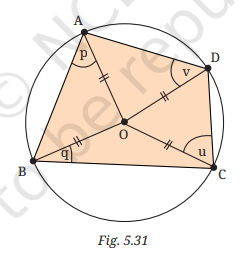
Let $ABCD$ be the cyclic quadrilateral with circumcentre $O$.
• Join $OA$, $OB$, $OC$, and $OD$. These segment are equal radii ($OA=OB=OC=OD=r$), dividing the quadrilateral into 4 isosceles triangles.
• Join $OA$, $OB$, $OC$, and $OD$. These segment are equal radii ($OA=OB=OC=OD=r$), dividing the quadrilateral into 4 isosceles triangles.
Let the base angles of these triangles be:
• In $\Delta OAB$: $\angle OAB = \angle OBA = q$
• In $\Delta OBC$: $\angle OBC = \angle OCB = u$
• In $\Delta OCD$: $\angle OCD = \angle ODC = v$
• In $\Delta ODA$: $\angle ODA = \angle OAD = p$
• In $\Delta OAB$: $\angle OAB = \angle OBA = q$
• In $\Delta OBC$: $\angle OBC = \angle OCB = u$
• In $\Delta OCD$: $\angle OCD = \angle ODC = v$
• In $\Delta ODA$: $\angle ODA = \angle OAD = p$
The interior angles of quadrilateral $ABCD$ are:
$$\angle A = p + q, \quad \angle B = q + u, \quad \angle C = u + v, \quad \angle D = v + p$$
$$\angle A = p + q, \quad \angle B = q + u, \quad \angle C = u + v, \quad \angle D = v + p$$
Sum of all interior angles of a quadrilateral is $360^\circ$:
$$\angle A + \angle B + \angle C + \angle D = 360^\circ$$
$$(p + q) + (q + u) + (u + v) + (v + p) = 360^\circ$$
$$2(p + q + u + v) = 360^\circ \implies p + q + u + v = 180^\circ$$
$$\angle A + \angle B + \angle C + \angle D = 360^\circ$$
$$(p + q) + (q + u) + (u + v) + (v + p) = 360^\circ$$
$$2(p + q + u + v) = 360^\circ \implies p + q + u + v = 180^\circ$$
Now compute sum of opposite angles:
$$\angle A + \angle C = (p + q) + (u + v) = p + q + u + v = \mathbf{180^\circ}$$
$$\angle B + \angle D = (q + u) + (v + p) = p + q + u + v = \mathbf{180^\circ}$$
This justifies the theorem.
$$\angle A + \angle C = (p + q) + (u + v) = p + q + u + v = \mathbf{180^\circ}$$
$$\angle B + \angle D = (q + u) + (v + p) = p + q + u + v = \mathbf{180^\circ}$$
This justifies the theorem.
Proved: Sum of opposite angles = p + q + u + v = 180°.