Exercise 5.4 Practice
00:00
Overview
This page provides comprehensive Ch 5: Circles - Exercise Set 5.4 Practice. Solve proofs using the Pythagoras theorem to show why equal chords are equidistant from the center, and geometric equivalence proofs for congruent chord lengths from equal perpendicular heights with step-by-step solutions.
Pythagorean Proofs of Equidistant Chords (Use Fig 5.15)
Q1: Pythagoras proof of Equidistance
Use the Baudhāyana–Pythagoras theorem to show why Theorem 6 must be true (Theorem 6: Equal chords of a circle are equidistant from the centre).
Let $AB$ and $CD$ be two equal chords of a circle with centre $O$ and radius $r$ ($AB = CD$).
Let $OM \perp AB$ and $ON \perp CD$. Since the perpendicular from the centre bisects the chord:
$$AM = \frac{AB}{2} \quad \text{and} \quad CN = \frac{CD}{2}$$
Since $AB = CD$, we have $AM = CN$.
Let $OM \perp AB$ and $ON \perp CD$. Since the perpendicular from the centre bisects the chord:
$$AM = \frac{AB}{2} \quad \text{and} \quad CN = \frac{CD}{2}$$
Since $AB = CD$, we have $AM = CN$.
In right-angled triangle $\Delta OMA$, by Baudhāyana-Pythagoras theorem:
$$OA^2 = OM^2 + AM^2 \implies r^2 = OM^2 + AM^2 \implies OM^2 = r^2 - AM^2$$
$$OA^2 = OM^2 + AM^2 \implies r^2 = OM^2 + AM^2 \implies OM^2 = r^2 - AM^2$$
In right-angled triangle $\Delta ONC$, by Baudhāyana-Pythagoras theorem:
$$OC^2 = ON^2 + CN^2 \implies r^2 = ON^2 + CN^2 \implies ON^2 = r^2 - CN^2$$
$$OC^2 = ON^2 + CN^2 \implies r^2 = ON^2 + CN^2 \implies ON^2 = r^2 - CN^2$$
Since $AM = CN \implies AM^2 = CN^2$, we can equate the two expressions:
$$OM^2 = r^2 - AM^2 = r^2 - CN^2 = ON^2 \implies OM = ON$$
Thus, equal chords are equidistant from the centre.
$$OM^2 = r^2 - AM^2 = r^2 - CN^2 = ON^2 \implies OM = ON$$
Thus, equal chords are equidistant from the centre.
Proved: OM = ON using Pythagoras theorem.
Q2: Chord Equality Proof
Consider Fig. 5.15. If $CE$ is perpendicular to $AB$, $CH$ is perpendicular to $GF$, and $CE = CH$, show that $AB = GF$.
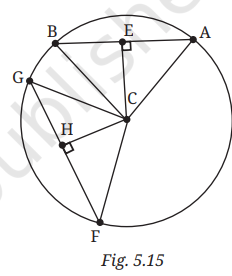
We are given a circle with centre $C$.
• $CE \perp AB$ and $CH \perp GF$ represent the perpendicular distances of chords $AB$ and $GF$ from the centre $C$.
• We are given that these distances are equal: $CE = CH$.
• $CE \perp AB$ and $CH \perp GF$ represent the perpendicular distances of chords $AB$ and $GF$ from the centre $C$.
• We are given that these distances are equal: $CE = CH$.
According to the theorem **"Chords equidistant from the centre of a circle are equal in length"**:
Since the perpendicular distances $CE$ and $CH$ are equal, the chords must be equal:
$$\mathbf{AB = GF}$$
Since the perpendicular distances $CE$ and $CH$ are equal, the chords must be equal:
$$\mathbf{AB = GF}$$
Proved: AB = GF by equidistant chord theorem.
Q3: Chord Equality using Pythagoras
Solve the previous question (Question 2) using the Baudhāyana–Pythagoras theorem.
Let the radius of the circle with centre $C$ be $r$. So $CA = CB = CG = CF = r$.
Since the perpendicular from the centre bisects the chord:
• $E$ is the midpoint of $AB \implies EB = \frac{AB}{2}$.
• $H$ is the midpoint of $GF \implies HG = \frac{GF}{2}$.
Since the perpendicular from the centre bisects the chord:
• $E$ is the midpoint of $AB \implies EB = \frac{AB}{2}$.
• $H$ is the midpoint of $GF \implies HG = \frac{GF}{2}$.
In right-angled triangle $\Delta CEB$, by Baudhāyana-Pythagoras theorem:
$$CB^2 = CE^2 + EB^2 \implies r^2 = CE^2 + \left(\frac{AB}{2}\right)^2 \implies \left(\frac{AB}{2}\right)^2 = r^2 - CE^2$$
$$CB^2 = CE^2 + EB^2 \implies r^2 = CE^2 + \left(\frac{AB}{2}\right)^2 \implies \left(\frac{AB}{2}\right)^2 = r^2 - CE^2$$
In right-angled triangle $\Delta CHG$, by Baudhāyana-Pythagoras theorem:
$$CG^2 = CH^2 + HG^2 \implies r^2 = CH^2 + \left(\frac{GF}{2}\right)^2 \implies \left(\frac{GF}{2}\right)^2 = r^2 - CH^2$$
$$CG^2 = CH^2 + HG^2 \implies r^2 = CH^2 + \left(\frac{GF}{2}\right)^2 \implies \left(\frac{GF}{2}\right)^2 = r^2 - CH^2$$
We are given $CE = CH \implies CE^2 = CH^2$. Therefore:
$$r^2 - CE^2 = r^2 - CH^2$$
Equating the two chord expressions:
$$\left(\frac{AB}{2}\right)^2 = \left(\frac{GF}{2}\right)^2 \implies \frac{AB}{2} = \frac{GF}{2} \implies \mathbf{AB = GF}$$
$$r^2 - CE^2 = r^2 - CH^2$$
Equating the two chord expressions:
$$\left(\frac{AB}{2}\right)^2 = \left(\frac{GF}{2}\right)^2 \implies \frac{AB}{2} = \frac{GF}{2} \implies \mathbf{AB = GF}$$
Proved: AB = GF using Pythagoras theorem.