Exercise 5.6 Practice
00:00
Overview
This page provides comprehensive Ch 5: Circles - Exercise Set 5.6 Practice. Solve problems on determining chord lengths from central angles, angles in the same segment of a circle, properties of concyclic points, and solving cyclic quadrilateral angle equations with step-by-step solutions.
Angle Properties in Segments & Cyclic Quadrilaterals
Q1: Chord Length from Central Angle
In a circle with centre $O$, the central angle $\angle AOB$ is $60^\circ$. If the radius of the circle is $12\text{ cm}$, what is the length of the chord $AB$?
Consider $\Delta OAB$ formed by the radii $OA$, $OB$, and chord $AB$:
• $OA = OB = 12\text{ cm}$ (radii of the circle)
• Since two sides are equal, the base angles are equal:
$$\angle OAB = \angle OBA$$
• $OA = OB = 12\text{ cm}$ (radii of the circle)
• Since two sides are equal, the base angles are equal:
$$\angle OAB = \angle OBA$$
Using the angle sum property of triangles in $\Delta OAB$:
$$\angle AOB + \angle OAB + \angle OBA = 180^\circ$$
$$60^\circ + 2\angle OAB = 180^\circ \implies 2\angle OAB = 120^\circ \implies \angle OAB = 60^\circ$$
$$\angle AOB + \angle OAB + \angle OBA = 180^\circ$$
$$60^\circ + 2\angle OAB = 180^\circ \implies 2\angle OAB = 120^\circ \implies \angle OAB = 60^\circ$$
Since all three angles of $\Delta OAB$ are $60^\circ$, the triangle is **equilateral**.
Therefore, the chord length $AB$ is equal to the radius:
$$AB = OA = OB = \mathbf{12\text{ cm}}$$
Therefore, the chord length $AB$ is equal to the radius:
$$AB = OA = OB = \mathbf{12\text{ cm}}$$
Length of chord AB = 12 cm
Q2: Same Segment Angle Properties
Let $A$ and $B$ be two points on a circle with centre $O$. Answer the following:
(i) Are there points $X, Y$ on the circle, on the same side of $AB$, such that $\angle AXB$ is different from $\angle AYB$?
(ii) Is it true that if $\angle AXB = \angle AYB$, then $X$ and $Y$ lie on the same side of the circle?
(iii) If $\angle AXB = \angle AYB$, and $X$ and $Y$ do not lie on the circle, does the circle through $A, B$ and $X$ also pass through $Y$?
(i) Are there points $X, Y$ on the circle, on the same side of $AB$, such that $\angle AXB$ is different from $\angle AYB$?
(ii) Is it true that if $\angle AXB = \angle AYB$, then $X$ and $Y$ lie on the same side of the circle?
(iii) If $\angle AXB = \angle AYB$, and $X$ and $Y$ do not lie on the circle, does the circle through $A, B$ and $X$ also pass through $Y$?
(i) Part One:
• **No**. By the segment theorem of circles: "Angles subtended by an arc in the same segment of a circle are equal."
• Therefore, $\angle AXB = \angle AYB$ for any points $X$ and $Y$ on the circle on the same side of $AB$.
• **No**. By the segment theorem of circles: "Angles subtended by an arc in the same segment of a circle are equal."
• Therefore, $\angle AXB = \angle AYB$ for any points $X$ and $Y$ on the circle on the same side of $AB$.
(ii) Part Two:
• **Yes** (in general). If $X$ and $Y$ were on opposite sides of $AB$ (opposite segments), they would subtend supplementary angles:
$$\angle AXB + \angle AYB = 180^\circ$$
If they are equal, they would both have to be $90^\circ$ (making $AB$ a diameter). For any other chord, they must lie on the same side of the chord.
• **Yes** (in general). If $X$ and $Y$ were on opposite sides of $AB$ (opposite segments), they would subtend supplementary angles:
$$\angle AXB + \angle AYB = 180^\circ$$
If they are equal, they would both have to be $90^\circ$ (making $AB$ a diameter). For any other chord, they must lie on the same side of the chord.
(iii) Part Three:
• **Yes**. If a line segment joining two points subtends equal angles at two other points on the same side of the line, the four points lie on the same circle (i.e. they are concyclic).
• Thus, the circle passing through $A, B, X$ must also pass through $Y$.
• **Yes**. If a line segment joining two points subtends equal angles at two other points on the same side of the line, the four points lie on the same circle (i.e. they are concyclic).
• Thus, the circle passing through $A, B, X$ must also pass through $Y$.
(i) No (ii) Yes (unless AB is diameter) (iii) Yes
Q3: Find x in Cyclic Quadrilateral
Find $x$ in Fig. 5.26.
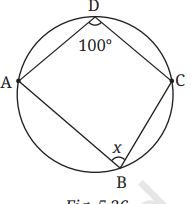
From Fig 5.26, we see a cyclic quadrilateral $ABCD$ inscribed in a circle.
• The opposite angles are $\angle D = 100^\circ$ and $\angle B = x$.
• The opposite angles are $\angle D = 100^\circ$ and $\angle B = x$.
The sum of the opposite angles of a cyclic quadrilateral is always $180^\circ$:
$$\angle D + \angle B = 180^\circ$$
$$100^\circ + x = 180^\circ$$
$$\angle D + \angle B = 180^\circ$$
$$100^\circ + x = 180^\circ$$
Solving for $x$:
$$x = 180^\circ - 100^\circ = \mathbf{80^\circ}$$
$$x = 180^\circ - 100^\circ = \mathbf{80^\circ}$$
x = 80°