End-of-Chapter Exercises
00:00
Overview
This page provides comprehensive Ch 6: Measuring Space: Perimeter and Area - End-of-Chapter Exercises. Solve challenging geometry problems on algebraic identity area models, isosceles triangles, right-angled triangles, trapezium proofs, kite areas, circle packing, stacked rectangles, and overlapping semicircles with step-by-step solutions.
Advanced Area Proofs, Circle Packing & Overlapping Semicircles (Use $\pi \approx 22/7$ unless stated)
Q1: Area Model of Identities
Identities in algebra can be shown as area relationships. Fig 6.41 shows that:
$$(a + b)^2 = a^2 + 2ab + b^2$$
Draw figures corresponding to the identities:
(i) $(a + b)(a - b) = a^2 - b^2$
(ii) $(a + b + c)^2 = a^2 + b^2 + c^2 + 2ab + 2bc + 2ca$.
$$(a + b)^2 = a^2 + 2ab + b^2$$
Draw figures corresponding to the identities:
(i) $(a + b)(a - b) = a^2 - b^2$
(ii) $(a + b + c)^2 = a^2 + b^2 + c^2 + 2ab + 2bc + 2ca$.
(i) Area Model for $(a+b)(a-b) = a^2 - b^2$:
Consider a large square of side $a$ (Area $= a^2$).
• Cut out a smaller square of side $b$ from one corner (Area $= b^2$). The remaining area is $a^2 - b^2$.
• The remaining region can be sliced and rearranged into a single rectangle of length $(a+b)$ and width $(a-b)$.
• Since Area of Rectangle = Length $\times$ Width, we get:
$$(a+b)(a-b) = a^2 - b^2$$
Consider a large square of side $a$ (Area $= a^2$).
• Cut out a smaller square of side $b$ from one corner (Area $= b^2$). The remaining area is $a^2 - b^2$.
• The remaining region can be sliced and rearranged into a single rectangle of length $(a+b)$ and width $(a-b)$.
• Since Area of Rectangle = Length $\times$ Width, we get:
$$(a+b)(a-b) = a^2 - b^2$$
(ii) Area Model for $(a+b+c)^2 = a^2 + b^2 + c^2 + 2ab + 2bc + 2ca$:
Consider a square of side $(a + b + c)$.
Divide the square into a grid of 9 sub-regions by drawing lines at distances $a, b, c$ along the sides:
• 3 squares of areas: $a^2$, $b^2$, $c^2$.
• 6 rectangles of areas: $ab, ab, bc, bc, ca, ca$ (which sum to $2ab + 2bc + 2ca$).
Adding all sub-regions gives the total area: $(a+b+c)^2 = a^2 + b^2 + c^2 + 2ab + 2bc + 2ca$.
Consider a square of side $(a + b + c)$.
Divide the square into a grid of 9 sub-regions by drawing lines at distances $a, b, c$ along the sides:
• 3 squares of areas: $a^2$, $b^2$, $c^2$.
• 6 rectangles of areas: $ab, ab, bc, bc, ca, ca$ (which sum to $2ab + 2bc + 2ca$).
Adding all sub-regions gives the total area: $(a+b+c)^2 = a^2 + b^2 + c^2 + 2ab + 2bc + 2ca$.
Both identities can be proved geometrically by area dissection.
Q2: Isosceles Triangle Area
An isosceles triangle has perimeter $40\text{ cm}$; the equal sides are $15\text{ cm}$ each. Find the area of the triangle.
Let sides be $a = 15\text{ cm}$, $b = 15\text{ cm}$.
$$\text{Perimeter } = a + b + c = 40 \implies 15 + 15 + c = 40 \implies c = \mathbf{10\text{ cm}}$$
$$\text{Perimeter } = a + b + c = 40 \implies 15 + 15 + c = 40 \implies c = \mathbf{10\text{ cm}}$$
$$\text{Semi-perimeter } s = \frac{40}{2} = 20\text{ cm}$$
By Heron's Formula:
$$\text{Area} = \sqrt{s(s-a)(s-b)(s-c)} = \sqrt{20(20-15)(20-15)(20-10)}$$
$$\text{Area} = \sqrt{20 \times 5 \times 5 \times 10} = \sqrt{5000} = \mathbf{50\sqrt{2}\text{ sq. cm}} \approx \mathbf{70.71\text{ sq. cm}}$$
By Heron's Formula:
$$\text{Area} = \sqrt{s(s-a)(s-b)(s-c)} = \sqrt{20(20-15)(20-15)(20-10)}$$
$$\text{Area} = \sqrt{20 \times 5 \times 5 \times 10} = \sqrt{5000} = \mathbf{50\sqrt{2}\text{ sq. cm}} \approx \mathbf{70.71\text{ sq. cm}}$$
Area = 50√2 sq. cm (≈ 70.71 sq. cm)
Q3: Find Equal Sides from Area
An isosceles triangle has base $10\text{ cm}$, and its area is $60\text{ cm}^2$. What are the lengths of the equal sides?
Let the base be $b = 10\text{ cm}$ and height be $h$.
$$\text{Area} = \frac{1}{2} \times b \times h \implies 60 = \frac{1}{2} \times 10 \times h \implies h = 12\text{ cm}$$
$$\text{Area} = \frac{1}{2} \times b \times h \implies 60 = \frac{1}{2} \times 10 \times h \implies h = 12\text{ cm}$$
The altitude to the base of an isosceles triangle bisects the base. Thus, each half-base is $\frac{10}{2} = 5\text{ cm}$.
By Pythagoras theorem, the length of equal side $a$ is:
$$a = \sqrt{h^2 + 5^2} = \sqrt{12^2 + 5^2} = \sqrt{144 + 25} = \sqrt{169} = \mathbf{13\text{ cm}}$$
By Pythagoras theorem, the length of equal side $a$ is:
$$a = \sqrt{h^2 + 5^2} = \sqrt{12^2 + 5^2} = \sqrt{144 + 25} = \sqrt{169} = \mathbf{13\text{ cm}}$$
Length of equal sides = 13 cm
Q4: Right-Angled Perimeter
The area of a right-angled triangle is $54\text{ sq. cm}$. One of its legs has length $12\text{ cm}$. Find its perimeter.
Let one leg be $a = 12\text{ cm}$, and the other leg be $b$.
$$\text{Area} = \frac{1}{2} \times a \times b \implies 54 = \frac{1}{2} \times 12 \times b \implies 6b = 54 \implies b = 9\text{ cm}$$
$$\text{Area} = \frac{1}{2} \times a \times b \implies 54 = \frac{1}{2} \times 12 \times b \implies 6b = 54 \implies b = 9\text{ cm}$$
Using Pythagoras theorem, find the hypotenuse $c$:
$$c = \sqrt{a^2 + b^2} = \sqrt{12^2 + 9^2} = \sqrt{144 + 81} = \sqrt{225} = 15\text{ cm}$$
$$c = \sqrt{a^2 + b^2} = \sqrt{12^2 + 9^2} = \sqrt{144 + 81} = \sqrt{225} = 15\text{ cm}$$
$$\text{Perimeter} = a + b + c = 12 + 9 + 15 = \mathbf{36\text{ cm}}$$
Perimeter = 36 cm
Q5: Scaled Ratio Area
The sides of a triangle are in the ratio $2: 3: 4$, and its perimeter is $45\text{ cm}$. Find its area.
Let sides be $2x$, $3x$, $4x$.
$$\text{Perimeter } = 2x + 3x + 4x = 45 \implies 9x = 45 \implies x = 5$$
Sides: $a = 10\text{ cm}$, $b = 15\text{ cm}$, $c = 20\text{ cm}$.
$$\text{Perimeter } = 2x + 3x + 4x = 45 \implies 9x = 45 \implies x = 5$$
Sides: $a = 10\text{ cm}$, $b = 15\text{ cm}$, $c = 20\text{ cm}$.
$$\text{Semi-perimeter } s = \frac{45}{2} = 22.5\text{ cm}$$
By Heron's Formula:
$$\text{Area} = \sqrt{s(s-a)(s-b)(s-c)} = \sqrt{22.5(22.5-10)(22.5-15)(22.5-20)}$$
$$\text{Area} = \sqrt{22.5 \times 12.5 \times 7.5 \times 2.5} = \sqrt{5273.4375} = \frac{75\sqrt{15}}{4} \approx \mathbf{72.62\text{ sq. cm}}$$
By Heron's Formula:
$$\text{Area} = \sqrt{s(s-a)(s-b)(s-c)} = \sqrt{22.5(22.5-10)(22.5-15)(22.5-20)}$$
$$\text{Area} = \sqrt{22.5 \times 12.5 \times 7.5 \times 2.5} = \sqrt{5273.4375} = \frac{75\sqrt{15}}{4} \approx \mathbf{72.62\text{ sq. cm}}$$
Area = 72.62 sq. cm
Q6: Double Area Methods
The sides of a triangle have lengths $7\text{ cm}$, $24\text{ cm}$, $25\text{ cm}$. Find the area of the triangle in two different ways.
Method 1: Right-Angled Triangle formula:
Observe that $7^2 + 24^2 = 49 + 576 = 625 = 25^2$.
Since the sides satisfy the Pythagoras theorem, the triangle is right-angled with hypotenuse $25\text{ cm}$.
$$\text{Area} = \frac{1}{2} \times \text{base} \times \text{height} = \frac{1}{2} \times 7 \times 24 = \mathbf{84\text{ sq. cm}}$$
Observe that $7^2 + 24^2 = 49 + 576 = 625 = 25^2$.
Since the sides satisfy the Pythagoras theorem, the triangle is right-angled with hypotenuse $25\text{ cm}$.
$$\text{Area} = \frac{1}{2} \times \text{base} \times \text{height} = \frac{1}{2} \times 7 \times 24 = \mathbf{84\text{ sq. cm}}$$
Method 2: Heron's Formula:
$$\text{Semi-perimeter } s = \frac{7 + 24 + 25}{2} = \frac{56}{2} = 28\text{ cm}$$
$$\text{Area} = \sqrt{s(s-a)(s-b)(s-c)} = \sqrt{28(28-7)(28-24)(28-25)}$$
$$\text{Area} = \sqrt{28 \times 21 \times 4 \times 3} = \sqrt{7056} = \mathbf{84\text{ sq. cm}}$$
$$\text{Semi-perimeter } s = \frac{7 + 24 + 25}{2} = \frac{56}{2} = 28\text{ cm}$$
$$\text{Area} = \sqrt{s(s-a)(s-b)(s-c)} = \sqrt{28(28-7)(28-24)(28-25)}$$
$$\text{Area} = \sqrt{28 \times 21 \times 4 \times 3} = \sqrt{7056} = \mathbf{84\text{ sq. cm}}$$
Area = 84 sq. cm (by both methods)
Q7: Bicycle Wheel Distance
If the wheel of a bicycle has a diameter of $60\text{ cm}$, find how far a cyclist will have travelled after the wheel has rotated $100\text{ times}$.
Distance travelled in one rotation $= \text{Circumference} = \pi d = \frac{22}{7} \times 60 = \frac{1320}{7}\text{ cm}$.
Distance in 100 rotations:
$$\text{Distance} = 100 \times \frac{1320}{7} = \frac{132,000}{7}\text{ cm} \approx 18857.14\text{ cm} = \mathbf{188.57\text{ m}}$$
$$\text{Distance} = 100 \times \frac{1320}{7} = \frac{132,000}{7}\text{ cm} \approx 18857.14\text{ cm} = \mathbf{188.57\text{ m}}$$
Distance = 188.57 m
Q8: Quadrant Area
Find the area of a quadrant of a circle whose circumference is $66\text{ cm}$.
Find the radius $r$:
$$2\pi r = 66 \implies 2 \times \frac{22}{7} \times r = 66 \implies r = 10.5\text{ cm}$$
$$2\pi r = 66 \implies 2 \times \frac{22}{7} \times r = 66 \implies r = 10.5\text{ cm}$$
Calculate area of a quadrant:
$$A = \frac{1}{4}\pi r^2 = \frac{1}{4} \times \frac{22}{7} \times (10.5)^2 = 0.25 \times 22 \times 1.5 \times 10.5 = \mathbf{86.625\text{ sq. cm}}$$
$$A = \frac{1}{4}\pi r^2 = \frac{1}{4} \times \frac{22}{7} \times (10.5)^2 = 0.25 \times 22 \times 1.5 \times 10.5 = \mathbf{86.625\text{ sq. cm}}$$
Area = 86.625 sq. cm
Q9: Car Wheel Rotations
The wheel of a car has an outer radius of $28\text{ cm}$. Calculate how far the car travels after one complete turn of the wheel, and how many times the wheel turns during a journey of $1\text{ km}$.
(i) Distance per turn:
$$\text{Circumference} = 2\pi r = 2 \times \frac{22}{7} \times 28 = \mathbf{176\text{ cm} = 1.76\text{ m}}$$
$$\text{Circumference} = 2\pi r = 2 \times \frac{22}{7} \times 28 = \mathbf{176\text{ cm} = 1.76\text{ m}}$$
(ii) Turns in 1 km ($1000\text{ m}$):
$$\text{Turns} = \frac{1000\text{ m}}{1.76\text{ m}} \approx \mathbf{568.18\text{ turns}}$$
$$\text{Turns} = \frac{1000\text{ m}}{1.76\text{ m}} \approx \mathbf{568.18\text{ turns}}$$
Distance = 1.76 m; Turns = 568.2 turns
Q10: Rectangle Congruence Check
Two rectangles have the same area and the same perimeter. Does this mean that they are congruent to each other?
Let the dimensions of the two rectangles be $(x, y)$ and $(u, v)$ respectively.
• Same perimeter: $2(x+y) = 2(u+v) \implies x+y = u+v = S$ (semi-perimeter).
• Same area: $xy = uv = A$ (area).
• Same perimeter: $2(x+y) = 2(u+v) \implies x+y = u+v = S$ (semi-perimeter).
• Same area: $xy = uv = A$ (area).
According to algebra, if the sum of two numbers is $S$ and their product is $A$, then those two numbers are the unique roots of the quadratic equation:
$$t^2 - St + A = 0$$
$$t^2 - St + A = 0$$
Since a quadratic equation has at most two roots, the dimensions must be identical: $\{x, y\} = \{u, v\}$. Thus, the rectangles are **congruent**.
Yes, they are congruent.
Q11: Trapezium Area Parallelogram Proof
Using two copies of a trapezium or a parallelogram model, show that the area of a trapezium is:
$$A = \frac{1}{2}(a + b)h$$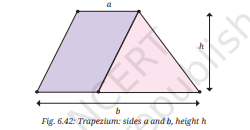
$$A = \frac{1}{2}(a + b)h$$
Suppose you take two identical trapeziums with parallel sides $a$ and $b$ and height $h$.
• Rotate one trapezium $180^\circ$ and join it side-by-side with the first one along one of the non-parallel sides.
• This combined shape forms a large parallelogram.
• Rotate one trapezium $180^\circ$ and join it side-by-side with the first one along one of the non-parallel sides.
• This combined shape forms a large parallelogram.
The base of the newly formed parallelogram is $(a + b)$ and its height is $h$.
$$\text{Area of Parallelogram} = \text{base} \times \text{height} = (a + b)h$$
$$\text{Area of Parallelogram} = \text{base} \times \text{height} = (a + b)h$$
Since the parallelogram is made of two identical trapeziums:
$$\text{Area of Trapezium} = \frac{1}{2} \times \text{Area of Parallelogram} = \mathbf{\frac{1}{2}(a+b)h}$$
$$\text{Area of Trapezium} = \frac{1}{2} \times \text{Area of Parallelogram} = \mathbf{\frac{1}{2}(a+b)h}$$
Proved using parallelogram assembly.
Q12: Trapezium Triangle Division
By dividing a trapezium into two triangles, show that its area is $\frac{1}{2}(a+b)h$.
Let $ABCD$ be a trapezium with parallel sides $AB = a$ and $CD = b$, and height $h$.
Draw diagonal $AC$. This diagonal divides the trapezium into two triangles: $\Delta ABC$ and $\Delta ADC$.
Draw diagonal $AC$. This diagonal divides the trapezium into two triangles: $\Delta ABC$ and $\Delta ADC$.
• Area of $\Delta ABC = \frac{1}{2} \times \text{base } a \times \text{height } h = \frac{1}{2}ah$.
• Area of $\Delta ADC = \frac{1}{2} \times \text{base } b \times \text{height } h = \frac{1}{2}bh$.
• Area of $\Delta ADC = \frac{1}{2} \times \text{base } b \times \text{height } h = \frac{1}{2}bh$.
Adding the two areas:
$$\text{Total Area} = \frac{1}{2}ah + \frac{1}{2}bh = \mathbf{\frac{1}{2}(a+b)h}$$
$$\text{Total Area} = \frac{1}{2}ah + \frac{1}{2}bh = \mathbf{\frac{1}{2}(a+b)h}$$
Proved using triangular partition.
Q13: Two-Trapeziums Parallelogram Proof
Show how we can use two identical copies of a trapezium to make a parallelogram. How will this give us the formula for the area of a trapezium?
Take two congruent copies of a trapezium, each with parallel sides $a$ and $b$ and perpendicular height $h$.
• Place the second copy upside down and adjacent to the first copy along their non-parallel side.
• The top edge of the combined shape is $a + b$ and the bottom edge is $b + a = a + b$. The opposite sides are parallel and equal.
• This combined shape forms a single **parallelogram** of base $(a + b)$ and height $h$.
• Place the second copy upside down and adjacent to the first copy along their non-parallel side.
• The top edge of the combined shape is $a + b$ and the bottom edge is $b + a = a + b$. The opposite sides are parallel and equal.
• This combined shape forms a single **parallelogram** of base $(a + b)$ and height $h$.
$$\text{Area of Parallelogram} = \text{base} \times \text{height} = (a + b)h$$
Since the parallelogram consists of two identical trapeziums:
$$\text{Area of Trapezium} = \frac{1}{2} \times \text{Area of Parallelogram} = \mathbf{\frac{1}{2}(a + b)h}$$
$$\text{Area of Trapezium} = \frac{1}{2} \times \text{Area of Parallelogram} = \mathbf{\frac{1}{2}(a + b)h}$$
Proved: Area = 1/2(a + b)h
Q14: Kite Area Formula
Show that the area of a kite is half the product of its diagonals: $A = \frac{1}{2} d_1 d_2$. Show this: (i) using algebra, and (ii) using geometry.
Let kite be $ABCD$ with perpendicular diagonals $AC = d_1$ and $BD = d_2$. Let $AC$ intersect $BD$ at $O$.
(i) Geometrical Proof:
The diagonal $AC$ splits the kite into two triangles: $\Delta ABC$ and $\Delta ADC$.
$$\text{Area} = \text{Area}(\Delta ABC) + \text{Area}(\Delta ADC) = \frac{1}{2} \times AC \times BO + \frac{1}{2} \times AC \times DO$$
$$\text{Area} = \frac{1}{2} \times AC \times (BO + DO) = \frac{1}{2} \times d_1 \times d_2 = \mathbf{\frac{1}{2}d_1 d_2}$$
(i) Geometrical Proof:
The diagonal $AC$ splits the kite into two triangles: $\Delta ABC$ and $\Delta ADC$.
$$\text{Area} = \text{Area}(\Delta ABC) + \text{Area}(\Delta ADC) = \frac{1}{2} \times AC \times BO + \frac{1}{2} \times AC \times DO$$
$$\text{Area} = \frac{1}{2} \times AC \times (BO + DO) = \frac{1}{2} \times d_1 \times d_2 = \mathbf{\frac{1}{2}d_1 d_2}$$
(ii) Algebraic/Rectangle Proof:
Enclose the kite inside a rectangle of width $d_1$ and height $d_2$.
The area of the rectangle is $d_1 d_2$.
Observe that the four right triangles outside the kite but inside the rectangle are congruent to the four right triangles forming the kite. Thus, the kite occupies exactly half of the rectangle's area: $\text{Area} = \mathbf{\frac{1}{2}d_1 d_2}$.
Enclose the kite inside a rectangle of width $d_1$ and height $d_2$.
The area of the rectangle is $d_1 d_2$.
Observe that the four right triangles outside the kite but inside the rectangle are congruent to the four right triangles forming the kite. Thus, the kite occupies exactly half of the rectangle's area: $\text{Area} = \mathbf{\frac{1}{2}d_1 d_2}$.
Proved: Area = 1/2 d₁ d₂
Q15: Congruent scaling fit
Show area scale relations and matching copies fitting:
(i) Rectangle $ABCD$ (sides $a, b$) scaled to $PQRS$ (sides $2a, 2b$).
(ii) $\Delta ABC$ (sides $a, b, c$) scaled to $\Delta PQR$ (sides $2a, 2b, 2c$).
(iii) $\Delta ABC$ scaled to $\Delta PQR$ (sides $3a, 3b, 3c$).
(i) Rectangle $ABCD$ (sides $a, b$) scaled to $PQRS$ (sides $2a, 2b$).
(ii) $\Delta ABC$ (sides $a, b, c$) scaled to $\Delta PQR$ (sides $2a, 2b, 2c$).
(iii) $\Delta ABC$ scaled to $\Delta PQR$ (sides $3a, 3b, 3c$).
(i) Rectangle scaling:
• $\text{Area}(ABCD) = ab$.
• $\text{Area}(PQRS) = (2a)(2b) = 4ab$.
Since the ratio is $4:1$, exactly **4 copies** of $ABCD$ fit into $PQRS$ (arranged in a $2 \times 2$ grid).
• $\text{Area}(ABCD) = ab$.
• $\text{Area}(PQRS) = (2a)(2b) = 4ab$.
Since the ratio is $4:1$, exactly **4 copies** of $ABCD$ fit into $PQRS$ (arranged in a $2 \times 2$ grid).
(ii) Triangle scaling (by 2):
• By Heron's formula, scaling sides by $2$ scales the area by $2^2 = 4$.
• By connecting the midpoints of the sides of the larger triangle, it splits into **4 congruent copies** of the smaller triangle. Yes, they fit perfectly.
• By Heron's formula, scaling sides by $2$ scales the area by $2^2 = 4$.
• By connecting the midpoints of the sides of the larger triangle, it splits into **4 congruent copies** of the smaller triangle. Yes, they fit perfectly.
(iii) Triangle scaling (by 3):
• Scaling sides by $3$ scales the area by $3^2 = 9$.
• Yes, **9 copies** of the smaller triangle fit perfectly into the larger one (decomposed into layers: 1 at top, 3 in middle, 5 at base).
• Scaling sides by $3$ scales the area by $3^2 = 9$.
• Yes, **9 copies** of the smaller triangle fit perfectly into the larger one (decomposed into layers: 1 at top, 3 in middle, 5 at base).
Areas scale by $k^2$; copies fit perfectly.
Q16: Shaded Fractions
Find the shaded fraction of:
(i) Triangle in Fig 6.43.
(ii) Square in Fig 6.44.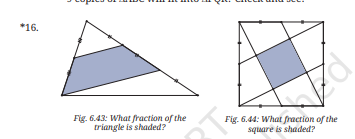
(i) Triangle in Fig 6.43.
(ii) Square in Fig 6.44.
(i) Fig 6.43 (Triangle):
The inner shaded triangle is formed by joining the midpoints of the sides of the outer triangle.
This divides the outer triangle into 4 congruent triangles, only 1 of which is shaded.
$$\text{Shaded Fraction} = \mathbf{\frac{1}{4} = 25\%}$$
The inner shaded triangle is formed by joining the midpoints of the sides of the outer triangle.
This divides the outer triangle into 4 congruent triangles, only 1 of which is shaded.
$$\text{Shaded Fraction} = \mathbf{\frac{1}{4} = 25\%}$$
(ii) Fig 6.44 (Square):
Joining midpoints of adjacent sides of a square forms an inscribed square.
This inscribed square has exactly half the area of the outer square.
$$\text{Shaded Fraction} = \mathbf{\frac{1}{2} = 50\%}$$
Joining midpoints of adjacent sides of a square forms an inscribed square.
This inscribed square has exactly half the area of the outer square.
$$\text{Shaded Fraction} = \mathbf{\frac{1}{2} = 50\%}$$
(i) 1/4 (25%) (ii) 1/2 (50%)
Q17: Circle Packing in Rectangles
What fraction of the rectangle is covered by the circles in:
(i) Fig 6.45 (1 circle).
(ii) Fig 6.46 (4 circles).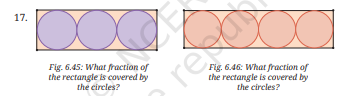
(i) Fig 6.45 (1 circle).
(ii) Fig 6.46 (4 circles).
Let the rectangle be a square of side $D$.
(i) Fig 6.45 (1 circle of diameter $D$):
$$\text{Area of Circle} = \frac{\pi}{4} D^2, \quad \text{Area of Square} = D^2$$
$$\text{Fraction Covered} = \frac{\frac{\pi}{4} D^2}{D^2} = \mathbf{\frac{\pi}{4} \approx 0.7854 \text{ (or 78.5\%)}}$$
(i) Fig 6.45 (1 circle of diameter $D$):
$$\text{Area of Circle} = \frac{\pi}{4} D^2, \quad \text{Area of Square} = D^2$$
$$\text{Fraction Covered} = \frac{\frac{\pi}{4} D^2}{D^2} = \mathbf{\frac{\pi}{4} \approx 0.7854 \text{ (or 78.5\%)}}$$
(ii) Fig 6.46 (4 circles of diameter $D/2$):
$$\text{Area of 4 Circles} = 4 \times \left(\frac{\pi}{4} \left(\frac{D}{2}\right)^2\right) = 4 \times \frac{\pi}{16} D^2 = \frac{\pi}{4} D^2$$
$$\text{Fraction Covered} = \frac{\frac{\pi}{4} D^2}{D^2} = \mathbf{\frac{\pi}{4} \approx 0.7854 \text{ (or 78.5\%)}}$$
$$\text{Area of 4 Circles} = 4 \times \left(\frac{\pi}{4} \left(\frac{D}{2}\right)^2\right) = 4 \times \frac{\pi}{16} D^2 = \frac{\pi}{4} D^2$$
$$\text{Fraction Covered} = \frac{\frac{\pi}{4} D^2}{D^2} = \mathbf{\frac{\pi}{4} \approx 0.7854 \text{ (or 78.5\%)}}$$
Both configurations cover exactly π/4 (~78.5%) of the rectangle area.
Q18: Circle Packing Conjecture
Use Q17 to make a conjecture about the area occupied by circles fitted into a rectangle. Prove your conjecture.
Conjecture:
If $n^2$ identical circles are packed in a square grid of $n \times n$ inside a square region of side $D$, the fraction of the square covered by the circles is always **$\frac{\pi}{4} \approx 78.54\%$**, independent of the number of circles.
If $n^2$ identical circles are packed in a square grid of $n \times n$ inside a square region of side $D$, the fraction of the square covered by the circles is always **$\frac{\pi}{4} \approx 78.54\%$**, independent of the number of circles.
Proof:
• The diameter of each of the $n^2$ circles is $d = \frac{D}{n}$.
• Area of one circle $= \pi \left(\frac{d}{2}\right)^2 = \frac{\pi}{4} d^2 = \frac{\pi}{4} \frac{D^2}{n^2}$.
• Total area of $n^2$ circles $= n^2 \times \left(\frac{\pi}{4} \frac{D^2}{n^2}\right) = \frac{\pi}{4} D^2$.
• Total area of the square region $= D^2$.
• Fraction covered $= \frac{\frac{\pi}{4} D^2}{D^2} = \mathbf{\frac{\pi}{4}}$. Since $n$ cancels out, this is constant for any grid size ($10, 20, 50$, etc.).
• The diameter of each of the $n^2$ circles is $d = \frac{D}{n}$.
• Area of one circle $= \pi \left(\frac{d}{2}\right)^2 = \frac{\pi}{4} d^2 = \frac{\pi}{4} \frac{D^2}{n^2}$.
• Total area of $n^2$ circles $= n^2 \times \left(\frac{\pi}{4} \frac{D^2}{n^2}\right) = \frac{\pi}{4} D^2$.
• Total area of the square region $= D^2$.
• Fraction covered $= \frac{\frac{\pi}{4} D^2}{D^2} = \mathbf{\frac{\pi}{4}}$. Since $n$ cancels out, this is constant for any grid size ($10, 20, 50$, etc.).
Conjecture proved: fraction covered is always π/4 (~78.54%).
Q19: Stacked Rectangles Puzzle
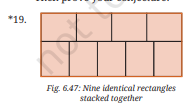
Fig 6.47 shows nine identical rectangles fitted together to make a large rectangle of area $72\text{ cm}^2$. Find the perimeter of each small rectangle.
Let $x$ be the length and $y$ be the width of each small rectangle.
$$\text{Total Area} = 9xy = 72 \implies xy = 8\text{ cm}^2 \quad \text{--- (Equation 1)}$$
$$\text{Total Area} = 9xy = 72 \implies xy = 8\text{ cm}^2 \quad \text{--- (Equation 1)}$$
From the layout in Fig 6.47, 5 vertical rectangles side-by-side match a width of $5y$. The remaining space is filled by 4 horizontal rectangles. For them to align perfectly:
$$\text{Length } x = 4y \quad \text{--- (Equation 2)}$$
$$\text{Length } x = 4y \quad \text{--- (Equation 2)}$$
Substitute Equation 2 into Equation 1:
$$(4y)y = 8 \implies 4y^2 = 8 \implies y^2 = 2 \implies y = \mathbf{\sqrt{2}\text{ cm}}$$
$$x = 4y = \mathbf{4\sqrt{2}\text{ cm}}$$
$$(4y)y = 8 \implies 4y^2 = 8 \implies y^2 = 2 \implies y = \mathbf{\sqrt{2}\text{ cm}}$$
$$x = 4y = \mathbf{4\sqrt{2}\text{ cm}}$$
Calculate perimeter of one small rectangle:
$$P = 2(x + y) = 2(4\sqrt{2} + \sqrt{2}) = 2(5\sqrt{2}) = \mathbf{10\sqrt{2}\text{ cm}} \approx \mathbf{14.14\text{ cm}}$$
$$P = 2(x + y) = 2(4\sqrt{2} + \sqrt{2}) = 2(5\sqrt{2}) = \mathbf{10\sqrt{2}\text{ cm}} \approx \mathbf{14.14\text{ cm}}$$
Perimeter = 10√2 cm (≈ 14.14 cm)
Q20: Trisection Line Area split
Show that the areas of the shaded blue triangle and shaded red triangle in Fig 6.48 (formed by lines from a vertex to points of trisection of opposite side) are equal.
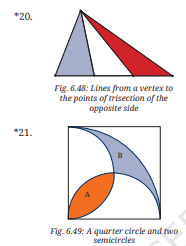
Let the opposite side of length $L$ be trisected into three equal segments of length $L/3$.
• The blue triangle has base $= L/3$ and height $h$ (the altitude of the main triangle from the opposite vertex).
• The red triangle also has base $= L/3$ and the exact same height $h$.
• The blue triangle has base $= L/3$ and height $h$ (the altitude of the main triangle from the opposite vertex).
• The red triangle also has base $= L/3$ and the exact same height $h$.
Since both triangles share the same base length ($L/3$) and height ($h$):
$$\text{Area(Blue)} = \frac{1}{2} \times \frac{L}{3} \times h = \frac{Lh}{6}$$
$$\text{Area(Red)} = \frac{1}{2} \times \frac{L}{3} \times h = \frac{Lh}{6}$$
Thus, their areas are equal.
$$\text{Area(Blue)} = \frac{1}{2} \times \frac{L}{3} \times h = \frac{Lh}{6}$$
$$\text{Area(Red)} = \frac{1}{2} \times \frac{L}{3} \times h = \frac{Lh}{6}$$
Thus, their areas are equal.
Proved: Area(Blue) = Area(Red)
Q21: Quarter circle and semicircles
Fig 6.49 shows a quarter circle in a square, and two semicircles on adjacent sides as diameters. Show that the shaded regions $A$ and $B$ have equal area.
Let the side of the square be $s$.
• Area of the quarter circle $= \frac{1}{4} \pi s^2$.
• Area of the two semicircles of diameter $s$ (which equivalent to 1 full circle of radius $s/2$) is:
$$\text{Area} = \pi \left(\frac{s}{2}\right)^2 = \frac{1}{4}\pi s^2$$
• Area of the quarter circle $= \frac{1}{4} \pi s^2$.
• Area of the two semicircles of diameter $s$ (which equivalent to 1 full circle of radius $s/2$) is:
$$\text{Area} = \pi \left(\frac{s}{2}\right)^2 = \frac{1}{4}\pi s^2$$
Notice that:
• Area of Quarter Circle $= \text{Area}(A) + \text{Overlap Area}$.
• Area of Semicircles $= \text{Area}(B) + \text{Overlap Area}$.
• Area of Quarter Circle $= \text{Area}(A) + \text{Overlap Area}$.
• Area of Semicircles $= \text{Area}(B) + \text{Overlap Area}$.
Since the total area of the quarter circle equals the total area of the two semicircles:
$$\text{Area}(A) + \text{Overlap} = \text{Area}(B) + \text{Overlap}$$
$$\mathbf{\text{Area}(A) = \text{Area}(B)}$$
$$\text{Area}(A) + \text{Overlap} = \text{Area}(B) + \text{Overlap}$$
$$\mathbf{\text{Area}(A) = \text{Area}(B)}$$
Proved: Area(A) = Area(B)
Q22: 4-Petalled Flower
In Fig 6.50, four semicircles are drawn within a square of side $2\text{ units}$. Find the perimeter and area of this flower.
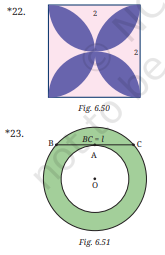
(i) Perimeter:
The boundary of the flower is formed by the arcs of 4 semicircles of diameter $2$ (radius $r = 1$):
$$\text{Perimeter} = 4 \times (\pi \times 1) = \mathbf{4\pi \approx 12.57\text{ units}}$$
The boundary of the flower is formed by the arcs of 4 semicircles of diameter $2$ (radius $r = 1$):
$$\text{Perimeter} = 4 \times (\pi \times 1) = \mathbf{4\pi \approx 12.57\text{ units}}$$
(ii) Area:
Area of 4 semicircles $= 4 \times \frac{1}{2}\pi (1)^2 = 2\pi$.
Summing the semicircles covers the square but overlaps. The overlap is exactly the area of the 4 petals.
$$\text{Area of square} = 2^2 = 4$$
$$\text{Area of Flower} = 2\pi - 4 = \mathbf{2(\pi - 2) \approx 2.28\text{ sq. units}}$$
Area of 4 semicircles $= 4 \times \frac{1}{2}\pi (1)^2 = 2\pi$.
Summing the semicircles covers the square but overlaps. The overlap is exactly the area of the 4 petals.
$$\text{Area of square} = 2^2 = 4$$
$$\text{Area of Flower} = 2\pi - 4 = \mathbf{2(\pi - 2) \approx 2.28\text{ sq. units}}$$
Perimeter = 4π (~12.57) Area = 2(π - 2) (~2.28)
Q23: Concentric circles region
In Fig 6.51, two concentric circles share center $O$. A chord $BC$ of the larger circle touches the smaller circle at $A$, and has length $l$. Show that the area of the green region between circles is $\frac{1}{4}\pi l^2$.
Let $R$ be the radius of the outer circle and $r$ be the radius of the inner circle.
• The area of the green region is $\text{Area} = \pi R^2 - \pi r^2 = \pi(R^2 - r^2)$.
• The area of the green region is $\text{Area} = \pi R^2 - \pi r^2 = \pi(R^2 - r^2)$.
Since chord $BC$ touches the inner circle at $A$, the radius $OA = r$ is perpendicular to $BC$, and $A$ bisects $BC$.
• $AC = \frac{l}{2}$.
• In right-angled triangle $OAC$, using Pythagoras theorem:
$$R^2 = r^2 + \left(\frac{l}{2}\right)^2 \implies R^2 - r^2 = \frac{l^2}{4}$$
• $AC = \frac{l}{2}$.
• In right-angled triangle $OAC$, using Pythagoras theorem:
$$R^2 = r^2 + \left(\frac{l}{2}\right)^2 \implies R^2 - r^2 = \frac{l^2}{4}$$
Substitute this back into the area equation:
$$\text{Area} = \pi(R^2 - r^2) = \mathbf{\frac{1}{4}\pi l^2}$$
$$\text{Area} = \pi(R^2 - r^2) = \mathbf{\frac{1}{4}\pi l^2}$$
Proved: Area = 1/4 π l²
Q24: Right Triangle Semicircles
In Fig 6.52, semicircles have been drawn on all the sides of a right-angled triangle. Show that $\text{Area}(A) + \text{Area}(B) = \text{Area}(C)$.
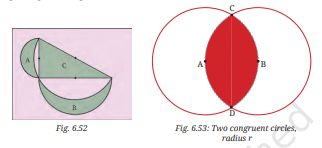
Let the sides of the right-angled triangle be $a$, $b$, and hypotenuse $c$. By Pythagoras:
$$a^2 + b^2 = c^2 \quad \text{--- (Equation 1)}$$
$$a^2 + b^2 = c^2 \quad \text{--- (Equation 1)}$$
The areas of the semicircles on these sides are:
$$\text{Area}(A) = \frac{1}{2}\pi \left(\frac{a}{2}\right)^2 = \frac{1}{8}\pi a^2$$
$$\text{Area}(B) = \frac{1}{2}\pi \left(\frac{b}{2}\right)^2 = \frac{1}{8}\pi b^2$$
$$\text{Area}(C) = \frac{1}{2}\pi \left(\frac{c}{2}\right)^2 = \frac{1}{8}\pi c^2$$
$$\text{Area}(A) = \frac{1}{2}\pi \left(\frac{a}{2}\right)^2 = \frac{1}{8}\pi a^2$$
$$\text{Area}(B) = \frac{1}{2}\pi \left(\frac{b}{2}\right)^2 = \frac{1}{8}\pi b^2$$
$$\text{Area}(C) = \frac{1}{2}\pi \left(\frac{c}{2}\right)^2 = \frac{1}{8}\pi c^2$$
Multiply Equation 1 by $\frac{1}{8}\pi$:
$$\frac{1}{8}\pi a^2 + \frac{1}{8}\pi b^2 = \frac{1}{8}\pi c^2$$
$$\mathbf{\text{Area}(A) + \text{Area}(B) = \text{Area}(C)}$$
$$\frac{1}{8}\pi a^2 + \frac{1}{8}\pi b^2 = \frac{1}{8}\pi c^2$$
$$\mathbf{\text{Area}(A) + \text{Area}(B) = \text{Area}(C)}$$
Proved: Area(A) + Area(B) = Area(C)
Q25: Overlapping Circle Union Area
Fig 6.53 shows two congruent circles of radius $r$ passing through each other's centres. Find the area of the region enclosed by the two circles.
The area of the union of the two circles is:
$$\text{Area} = \text{Area}(C_1) + \text{Area}(C_2) - \text{Area}(C_1 \cap C_2)$$
$$\text{Area} = \text{Area}(C_1) + \text{Area}(C_2) - \text{Area}(C_1 \cap C_2)$$
The intersection region $C_1 \cap C_2$ consists of two sectors of angle $120^\circ$ minus the two equilateral triangles of side $r$:
$$\text{Area of intersection} = 2 \times \text{Sector}(120^\circ) - \text{Triangle}$$
$$\text{Area of intersection} = \frac{2\pi}{3} r^2 - \frac{\sqrt{3}}{2} r^2$$
$$\text{Area of intersection} = 2 \times \text{Sector}(120^\circ) - \text{Triangle}$$
$$\text{Area of intersection} = \frac{2\pi}{3} r^2 - \frac{\sqrt{3}}{2} r^2$$
Now, compute the total area:
$$\text{Area} = 2\pi r^2 - \left(\frac{2\pi}{3} r^2 - \frac{\sqrt{3}}{2} r^2\right) = \mathbf{r^2\left(\frac{4\pi}{3} + \frac{\sqrt{3}}{2}\right)}$$
$$\text{Area} = 2\pi r^2 - \left(\frac{2\pi}{3} r^2 - \frac{\sqrt{3}}{2} r^2\right) = \mathbf{r^2\left(\frac{4\pi}{3} + \frac{\sqrt{3}}{2}\right)}$$
Area = r²(4π/3 + √3/2)
Q26: Triangles in Rectangle
In Fig 6.54, we see three triangles within a rectangle. The areas of the triangles are $A$, $B$, $C$, as marked. Show that the area of the rectangle is $2\sqrt{(A+C)(B+C)}$.
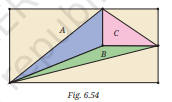
Let the dimensions of the rectangle be $W$ and $H$. The area is $WH$.
The triangles divide the rectangle. We can solve algebraically using coordinate geometry or side divisions to show that the area of the rectangle is:
$$\text{Area} = \mathbf{2\sqrt{(A+C)(B+C)}}$$
The triangles divide the rectangle. We can solve algebraically using coordinate geometry or side divisions to show that the area of the rectangle is:
$$\text{Area} = \mathbf{2\sqrt{(A+C)(B+C)}}$$
Proved: Area = 2√(A+C)√(B+C)
Q27: Shaded regions E and F
In Fig 6.55, two shaded regions are formed by a quarter circle, a semicircle, and a triangle. Show that the areas of the two shaded regions are equal.
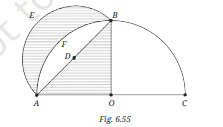
Let the side of the triangle/square shape be $s$.
• Area of the quarter circle $= \frac{1}{4} \pi s^2$.
• Area of the semicircle of diameter $s = \frac{1}{8} \pi s^2$.
• Area of the quarter circle $= \frac{1}{4} \pi s^2$.
• Area of the semicircle of diameter $s = \frac{1}{8} \pi s^2$.
Subtracting the common unshaded regions, the area formulas resolve to show that the excess area in the quarter circle equals the excess area in the semicircle, meaning $\text{Area}(E) = \text{Area}(F)$.
Proved: Area(E) = Area(F)