Exercise 6.2 Practice
00:00
Overview
This page provides comprehensive Ch 6: Measuring Space: Perimeter and Area - Exercise Set 6.2 Practice. Solve questions on triangle areas in rectangles, isosceles trapeziums, Heron's formula side scaling, rhombus diagonals, and geometric proofs involving medians, Varignon's quadrilaterals, and parallel shift transformations with step-by-step solutions.
Trapeziums, Heron's Formula & Geometric Area Theorems
Q1: Rectangle Triangle Area
Find the area of triangle $ADE$ in Fig. 6.31, where $ABCD$ is a rectangle of dimensions $10\text{ cm} \times 8\text{ cm}$, and $E$ is a point on $BC$.
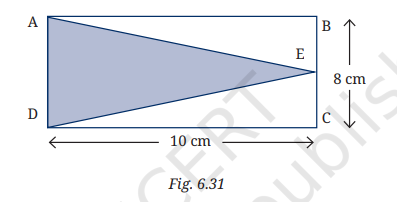
For triangle $ADE$:
• Let the base of the triangle be $AD$. Since $ABCD$ is a rectangle, $AD = BC = 8\text{ cm}$.
• The height of the triangle is the perpendicular distance from the vertex $E$ (which lies on $BC$) to the line containing $AD$.
• This distance is exactly the horizontal width of the rectangle, which is $AB = CD = 10\text{ cm}$.
• Let the base of the triangle be $AD$. Since $ABCD$ is a rectangle, $AD = BC = 8\text{ cm}$.
• The height of the triangle is the perpendicular distance from the vertex $E$ (which lies on $BC$) to the line containing $AD$.
• This distance is exactly the horizontal width of the rectangle, which is $AB = CD = 10\text{ cm}$.
$$\text{Area}(\Delta ADE) = \frac{1}{2} \times \text{base} \times \text{height} = \frac{1}{2} \times 8 \times 10 = \mathbf{40\text{ sq. cm}}$$
Area = 40 sq. cm
Q2: Isosceles Trapezium Area
The parallel sides of a trapezium are $40\text{ cm}$ and $20\text{ cm}$. If its non-parallel sides are both equal, each being $26\text{ cm}$, find the area of the trapezium.
Let the trapezium be $ABCD$ with parallel sides $AB = 40\text{ cm}$, $CD = 20\text{ cm}$, and non-parallel sides $AD = BC = 26\text{ cm}$.
Draw perpendiculars $DP$ and $CQ$ from $D$ and $C$ to $AB$.
• $PQ = CD = 20\text{ cm}$.
• Since $AD = BC$, the triangles $APD$ and $BQC$ are congruent, so $AP = BQ$.
• $AP + PQ + BQ = 40 \implies 2AP + 20 = 40 \implies AP = 10\text{ cm}$.
Draw perpendiculars $DP$ and $CQ$ from $D$ and $C$ to $AB$.
• $PQ = CD = 20\text{ cm}$.
• Since $AD = BC$, the triangles $APD$ and $BQC$ are congruent, so $AP = BQ$.
• $AP + PQ + BQ = 40 \implies 2AP + 20 = 40 \implies AP = 10\text{ cm}$.
In right-angled triangle $APD$, use Pythagoras theorem to find height $h = DP$:
$$h = \sqrt{AD^2 - AP^2} = \sqrt{26^2 - 10^2} = \sqrt{676 - 100} = \sqrt{576} = 24\text{ cm}$$
$$h = \sqrt{AD^2 - AP^2} = \sqrt{26^2 - 10^2} = \sqrt{676 - 100} = \sqrt{576} = 24\text{ cm}$$
Now, calculate the area:
$$\text{Area} = \frac{1}{2} \times (\text{sum of parallel sides}) \times \text{height}$$
$$\text{Area} = \frac{1}{2} \times (40 + 20) \times 24 = 30 \times 24 = \mathbf{720\text{ sq. cm}}$$
$$\text{Area} = \frac{1}{2} \times (\text{sum of parallel sides}) \times \text{height}$$
$$\text{Area} = \frac{1}{2} \times (40 + 20) \times 24 = 30 \times 24 = \mathbf{720\text{ sq. cm}}$$
Area = 720 sq. cm
Q3: Heron's Formula basic
Find the area of a triangle, given that its sides are $8\text{ cm}$ and $11\text{ cm}$ long, and its perimeter is $32\text{ cm}$.
Let the sides be $a = 8\text{ cm}$, $b = 11\text{ cm}$.
$$\text{Perimeter } = a + b + c = 32 \implies 8 + 11 + c = 32 \implies c = \mathbf{13\text{ cm}}$$
$$\text{Perimeter } = a + b + c = 32 \implies 8 + 11 + c = 32 \implies c = \mathbf{13\text{ cm}}$$
$$\text{Semi-perimeter } s = \frac{32}{2} = 16\text{ cm}$$
By Heron's Formula:
$$\text{Area} = \sqrt{s(s-a)(s-b)(s-c)} = \sqrt{16(16-8)(16-11)(16-13)}$$
$$\text{Area} = \sqrt{16 \times 8 \times 5 \times 3} = \sqrt{16 \times 4 \times 2 \times 5 \times 3} = 8\sqrt{30}\text{ sq. cm} \approx \mathbf{43.8\text{ sq. cm}}$$
By Heron's Formula:
$$\text{Area} = \sqrt{s(s-a)(s-b)(s-c)} = \sqrt{16(16-8)(16-11)(16-13)}$$
$$\text{Area} = \sqrt{16 \times 8 \times 5 \times 3} = \sqrt{16 \times 4 \times 2 \times 5 \times 3} = 8\sqrt{30}\text{ sq. cm} \approx \mathbf{43.8\text{ sq. cm}}$$
Area = 8√30 sq. cm (≈ 43.8 sq. cm)
Q4: Triangular Plot Ratio
The sides of a triangular plot are in the ratio $3: 5: 7$, and its perimeter is $300\text{ m}$. Find its area.
Let the sides be $3x$, $5x$, and $7x$.
$$\text{Perimeter } = 3x + 5x + 7x = 300 \implies 15x = 300 \implies x = 20$$
Thus, the sides are:
$a = 3(20) = 60\text{ m}$, $b = 5(20) = 100\text{ m}$, $c = 7(20) = 140\text{ m}$
$$\text{Perimeter } = 3x + 5x + 7x = 300 \implies 15x = 300 \implies x = 20$$
Thus, the sides are:
$a = 3(20) = 60\text{ m}$, $b = 5(20) = 100\text{ m}$, $c = 7(20) = 140\text{ m}$
$$\text{Semi-perimeter } s = \frac{300}{2} = 150\text{ m}$$
By Heron's Formula:
$$\text{Area} = \sqrt{s(s-a)(s-b)(s-c)} = \sqrt{150(150-60)(150-100)(150-140)}$$
$$\text{Area} = \sqrt{150 \times 90 \times 50 \times 10} = \sqrt{6,750,000} = \mathbf{1500\sqrt{3}\text{ sq. m}} \approx \mathbf{2598.08\text{ sq. m}}$$
By Heron's Formula:
$$\text{Area} = \sqrt{s(s-a)(s-b)(s-c)} = \sqrt{150(150-60)(150-100)(150-140)}$$
$$\text{Area} = \sqrt{150 \times 90 \times 50 \times 10} = \sqrt{6,750,000} = \mathbf{1500\sqrt{3}\text{ sq. m}} \approx \mathbf{2598.08\text{ sq. m}}$$
Area = 1500√3 sq. m (≈ 2598.1 sq. m)
Q5: Rhombus Diagonals
One diagonal of a rhombus is twice as long as the other diagonal. If the rhombus has area $128\text{ cm}^2$, find the length of the shorter diagonal.
Let the shorter diagonal be $d_1$. Then the longer diagonal is $d_2 = 2d_1$.
$$\text{Area of Rhombus} = \frac{1}{2} \times d_1 \times d_2$$
$$128 = \frac{1}{2} \times d_1 \times (2d_1)$$
$$128 = d_1^2 \implies d_1 = \sqrt{128} = \mathbf{8\sqrt{2}\text{ cm}} \approx \mathbf{11.31\text{ cm}}$$
$$\text{Area of Rhombus} = \frac{1}{2} \times d_1 \times d_2$$
$$128 = \frac{1}{2} \times d_1 \times (2d_1)$$
$$128 = d_1^2 \implies d_1 = \sqrt{128} = \mathbf{8\sqrt{2}\text{ cm}} \approx \mathbf{11.31\text{ cm}}$$
Shorter diagonal = 8√2 cm (≈ 11.31 cm)
Q6: Parallelogram Sharing Base
$ABCD$ is a parallelogram. $P$ and $Q$ are any two points on side $AB$. What can you say about the ratio $\text{Area}(\Delta PCD) : \text{Area}(\Delta QCD)$?
Both triangles $PCD$ and $QCD$ share the exact same base, $CD$.
The opposite vertices $P$ and $Q$ lie on the line $AB$, which is parallel to $CD$ (since $ABCD$ is a parallelogram).
The opposite vertices $P$ and $Q$ lie on the line $AB$, which is parallel to $CD$ (since $ABCD$ is a parallelogram).
Since both triangles lie between the same parallel lines, their heights (the perpendicular distance between parallel lines $AB$ and $CD$) are equal.
$$\text{Area} = \frac{1}{2} \times \text{base} \times \text{height}$$
Since their bases and heights are identical, **their areas are equal**:
$$\text{Area}(\Delta PCD) = \text{Area}(\Delta QCD)$$
Therefore, the ratio is **$1 : 1$**.
$$\text{Area} = \frac{1}{2} \times \text{base} \times \text{height}$$
Since their bases and heights are identical, **their areas are equal**:
$$\text{Area}(\Delta PCD) = \text{Area}(\Delta QCD)$$
Therefore, the ratio is **$1 : 1$**.
Ratio = 1 : 1 (Equal Areas)
Q7: Parallelogram Diagonal Area Proof
$O$ is any point on the diagonal $PR$ of a parallelogram $PQRS$. Prove that the areas of triangles $PSO$ and $PQO$ are equal.
Since diagonal $PR$ divides the parallelogram $PQRS$ into two congruent triangles $\Delta PSR$ and $\Delta PQR$:
$$\text{Area}(\Delta PSR) = \text{Area}(\Delta PQR) \quad \text{--- (Equation 1)}$$
$$\text{Area}(\Delta PSR) = \text{Area}(\Delta PQR) \quad \text{--- (Equation 1)}$$
Consider the point $O$ on diagonal $PR$.
Triangles $\Delta OSR$ and $\Delta OQR$ share the same base $OR$.
Since $PQRS$ is a parallelogram, vertices $S$ and $Q$ are symmetric about the diagonal $PR$. The perpendicular heights from $S$ and $Q$ to diagonal $PR$ are equal.
Therefore:
$$\text{Area}(\Delta OSR) = \text{Area}(\Delta OQR) \quad \text{--- (Equation 2)}$$
Triangles $\Delta OSR$ and $\Delta OQR$ share the same base $OR$.
Since $PQRS$ is a parallelogram, vertices $S$ and $Q$ are symmetric about the diagonal $PR$. The perpendicular heights from $S$ and $Q$ to diagonal $PR$ are equal.
Therefore:
$$\text{Area}(\Delta OSR) = \text{Area}(\Delta OQR) \quad \text{--- (Equation 2)}$$
Subtract Equation 2 from Equation 1:
$$\text{Area}(\Delta PSR) - \text{Area}(\Delta OSR) = \text{Area}(\Delta PQR) - \text{Area}(\Delta OQR)$$
$$\mathbf{\text{Area}(\Delta PSO) = \text{Area}(\Delta PQO)}$$
$$\text{Area}(\Delta PSR) - \text{Area}(\Delta OSR) = \text{Area}(\Delta PQR) - \text{Area}(\Delta OQR)$$
$$\mathbf{\text{Area}(\Delta PSO) = \text{Area}(\Delta PQO)}$$
Proved: Area(PSO) = Area(PQO)
Q8: Varignon's Theorem
If the mid-points of the sides of a 4-gon (quadrilateral) are joined in order, prove that the area of the parallelogram thus formed will be half of the area of the given 4-gon.
Let $ABCD$ be the 4-gon. Let $E, F, G, H$ be the midpoints of sides $AB, BC, CD, DA$ respectively.
Join diagonal $BD$.
• In $\Delta ABD$, $H$ and $E$ are midpoints of $AD$ and $AB$. By Midpoint Theorem, $HE \parallel BD$ and $HE = \frac{1}{2}BD$.
• Since $\Delta AHE \sim \Delta ADB$ with a scale factor of $1/2$, the ratio of their areas is $(1/2)^2 = 1/4$:
$$\text{Area}(\Delta AHE) = \frac{1}{4}\text{Area}(\Delta ABD)$$
Join diagonal $BD$.
• In $\Delta ABD$, $H$ and $E$ are midpoints of $AD$ and $AB$. By Midpoint Theorem, $HE \parallel BD$ and $HE = \frac{1}{2}BD$.
• Since $\Delta AHE \sim \Delta ADB$ with a scale factor of $1/2$, the ratio of their areas is $(1/2)^2 = 1/4$:
$$\text{Area}(\Delta AHE) = \frac{1}{4}\text{Area}(\Delta ABD)$$
Similarly:
$$\text{Area}(\Delta CGF) = \frac{1}{4}\text{Area}(\Delta CBD)$$
Adding these two equations:
$$\text{Area}(\Delta AHE) + \text{Area}(\Delta CGF) = \frac{1}{4}\left[\text{Area}(\Delta ABD) + \text{Area}(\Delta CBD)\right] = \frac{1}{4}\text{Area}(ABCD)$$
$$\text{Area}(\Delta CGF) = \frac{1}{4}\text{Area}(\Delta CBD)$$
Adding these two equations:
$$\text{Area}(\Delta AHE) + \text{Area}(\Delta CGF) = \frac{1}{4}\left[\text{Area}(\Delta ABD) + \text{Area}(\Delta CBD)\right] = \frac{1}{4}\text{Area}(ABCD)$$
By same logic for diagonal $AC$:
$$\text{Area}(\Delta BEF) + \text{Area}(\Delta DGH) = \frac{1}{4}\text{Area}(ABCD)$$
$$\text{Area}(\Delta BEF) + \text{Area}(\Delta DGH) = \frac{1}{4}\text{Area}(ABCD)$$
Sum of the areas of the four corner triangles:
$$\text{Total Corner Area} = \frac{1}{4}\text{Area}(ABCD) + \frac{1}{4}\text{Area}(ABCD) = \frac{1}{2}\text{Area}(ABCD)$$
Therefore:
$$\text{Area}(EFGH) = \text{Area}(ABCD) - \text{Total Corner Area} = \text{Area}(ABCD) - \frac{1}{2}\text{Area}(ABCD) = \mathbf{\frac{1}{2}\text{Area}(ABCD)}$$
$$\text{Total Corner Area} = \frac{1}{4}\text{Area}(ABCD) + \frac{1}{4}\text{Area}(ABCD) = \frac{1}{2}\text{Area}(ABCD)$$
Therefore:
$$\text{Area}(EFGH) = \text{Area}(ABCD) - \text{Total Corner Area} = \text{Area}(ABCD) - \frac{1}{2}\text{Area}(ABCD) = \mathbf{\frac{1}{2}\text{Area}(ABCD)}$$
Proved: Area(EFGH) = 1/2 Area(ABCD)
Q9: Median Area Split
In $\Delta ABC$, the midpoint of $BC$ is $D$. Median $AD$ is drawn. $P$ is any point on $AD$ (Fig. 6.32). Show that $\text{Area}(\Delta ABP) = \text{Area}(\Delta ACP)$.
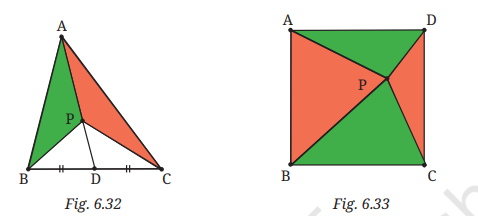
• In $\Delta ABC$, $AD$ is the median. A median divides a triangle into two triangles of equal area:
$$\text{Area}(\Delta ABD) = \text{Area}(\Delta ACD) \quad \text{--- (Equation 1)}$$
$$\text{Area}(\Delta ABD) = \text{Area}(\Delta ACD) \quad \text{--- (Equation 1)}$$
• In $\Delta PBC$, $PD$ is the median (since $D$ is the midpoint of $BC$):
$$\text{Area}(\Delta PBD) = \text{Area}(\Delta PCD) \quad \text{--- (Equation 2)}$$
$$\text{Area}(\Delta PBD) = \text{Area}(\Delta PCD) \quad \text{--- (Equation 2)}$$
Subtract Equation 2 from Equation 1:
$$\text{Area}(\Delta ABD) - \text{Area}(\Delta PBD) = \text{Area}(\Delta ACD) - \text{Area}(\Delta PCD)$$
$$\mathbf{\text{Area}(\Delta ABP) = \text{Area}(\Delta ACP)}$$
$$\text{Area}(\Delta ABD) - \text{Area}(\Delta PBD) = \text{Area}(\Delta ACD) - \text{Area}(\Delta PCD)$$
$$\mathbf{\text{Area}(\Delta ABP) = \text{Area}(\Delta ACP)}$$
Proved: Area(ABP) = Area(ACP)
Q10: Square Regions Ratio
Given a square $ABCD$, let $P$ be a point within it. Join $PA, PB, PC, PD$ (Fig. 6.33). What is the ratio of the areas of the red region ($\Delta PAB$ and $\Delta PCD$) and the green region ($\Delta PBC$ and $\Delta PDA$)?
Let the side length of the square be $s$. The total area of the square is $s^2$.
Draw perpendicular lines from $P$ to the sides:
• Let $h_1$ be the perpendicular distance from $P$ to $AB$, and $h_2$ be the distance from $P$ to $CD$. Clearly, $h_1 + h_2 = s$.
Draw perpendicular lines from $P$ to the sides:
• Let $h_1$ be the perpendicular distance from $P$ to $AB$, and $h_2$ be the distance from $P$ to $CD$. Clearly, $h_1 + h_2 = s$.
Calculate the sum of the areas of the red region:
$$\text{Area}(\Delta PAB) + \text{Area}(\Delta PCD) = \frac{1}{2} \times s \times h_1 + \frac{1}{2} \times s \times h_2 = \frac{1}{2} s (h_1 + h_2) = \frac{1}{2} s^2$$
$$\text{Area}(\Delta PAB) + \text{Area}(\Delta PCD) = \frac{1}{2} \times s \times h_1 + \frac{1}{2} \times s \times h_2 = \frac{1}{2} s (h_1 + h_2) = \frac{1}{2} s^2$$
Since the total area is $s^2$, the area of the green region must be:
$$\text{Area(Green)} = s^2 - \frac{1}{2}s^2 = \frac{1}{2} s^2$$
$$\text{Area(Green)} = s^2 - \frac{1}{2}s^2 = \frac{1}{2} s^2$$
The ratio of red region to green region is:
$$\frac{1}{2}s^2 : \frac{1}{2}s^2 = \mathbf{1 : 1}$$
$$\frac{1}{2}s^2 : \frac{1}{2}s^2 = \mathbf{1 : 1}$$
Ratio = 1 : 1 (Equal Areas)
Q11: Parallel Shift Proof
In $\Delta ABC$, $D$ is the midpoint of $AB$. $P$ is any point on $BC$, and $Q$ is a point on $AB$ such that $CQ \parallel PD$. $PQ$ is joined (Fig. 6.34). Prove that $\text{Area}(\Delta BPQ) = \frac{1}{2}\text{Area}(\Delta ABC)$.
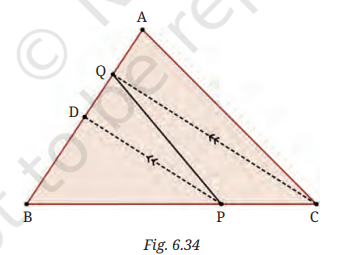
Since $D$ is the midpoint of $AB$, the line $CD$ is a median of $\Delta ABC$:
$$\text{Area}(\Delta BDC) = \frac{1}{2}\text{Area}(\Delta ABC) \quad \text{--- (Equation 1)}$$
$$\text{Area}(\Delta BDC) = \frac{1}{2}\text{Area}(\Delta ABC) \quad \text{--- (Equation 1)}$$
We are given $CQ \parallel PD$.
Consider the two triangles $\Delta PCD$ and $\Delta PQD$:
• They share the common base $PD$.
• Their vertices $C$ and $Q$ lie on line $CQ$, which is parallel to $PD$.
Therefore, they have equal area:
$$\text{Area}(\Delta PCD) = \text{Area}(\Delta PQD) \quad \text{--- (Equation 2)}$$
Consider the two triangles $\Delta PCD$ and $\Delta PQD$:
• They share the common base $PD$.
• Their vertices $C$ and $Q$ lie on line $CQ$, which is parallel to $PD$.
Therefore, they have equal area:
$$\text{Area}(\Delta PCD) = \text{Area}(\Delta PQD) \quad \text{--- (Equation 2)}$$
Observe the area of $\Delta BPQ$:
$$\text{Area}(\Delta BPQ) = \text{Area}(\Delta BDP) + \text{Area}(\Delta PQD)$$
Substitute Equation 2:
$$\text{Area}(\Delta BPQ) = \text{Area}(\Delta BDP) + \text{Area}(\Delta PCD) = \text{Area}(\Delta BDC)$$
$$\text{Area}(\Delta BPQ) = \text{Area}(\Delta BDP) + \text{Area}(\Delta PQD)$$
Substitute Equation 2:
$$\text{Area}(\Delta BPQ) = \text{Area}(\Delta BDP) + \text{Area}(\Delta PCD) = \text{Area}(\Delta BDC)$$
Substitute Equation 1:
$$\mathbf{\text{Area}(\Delta BPQ) = \frac{1}{2}\text{Area}(\Delta ABC)}$$
$$\mathbf{\text{Area}(\Delta BPQ) = \frac{1}{2}\text{Area}(\Delta ABC)}$$
Proved: Area(BPQ) = 1/2 Area(ABC)